

By: Ali Kazemkhani
This Can’t Be Just Bad Luck...
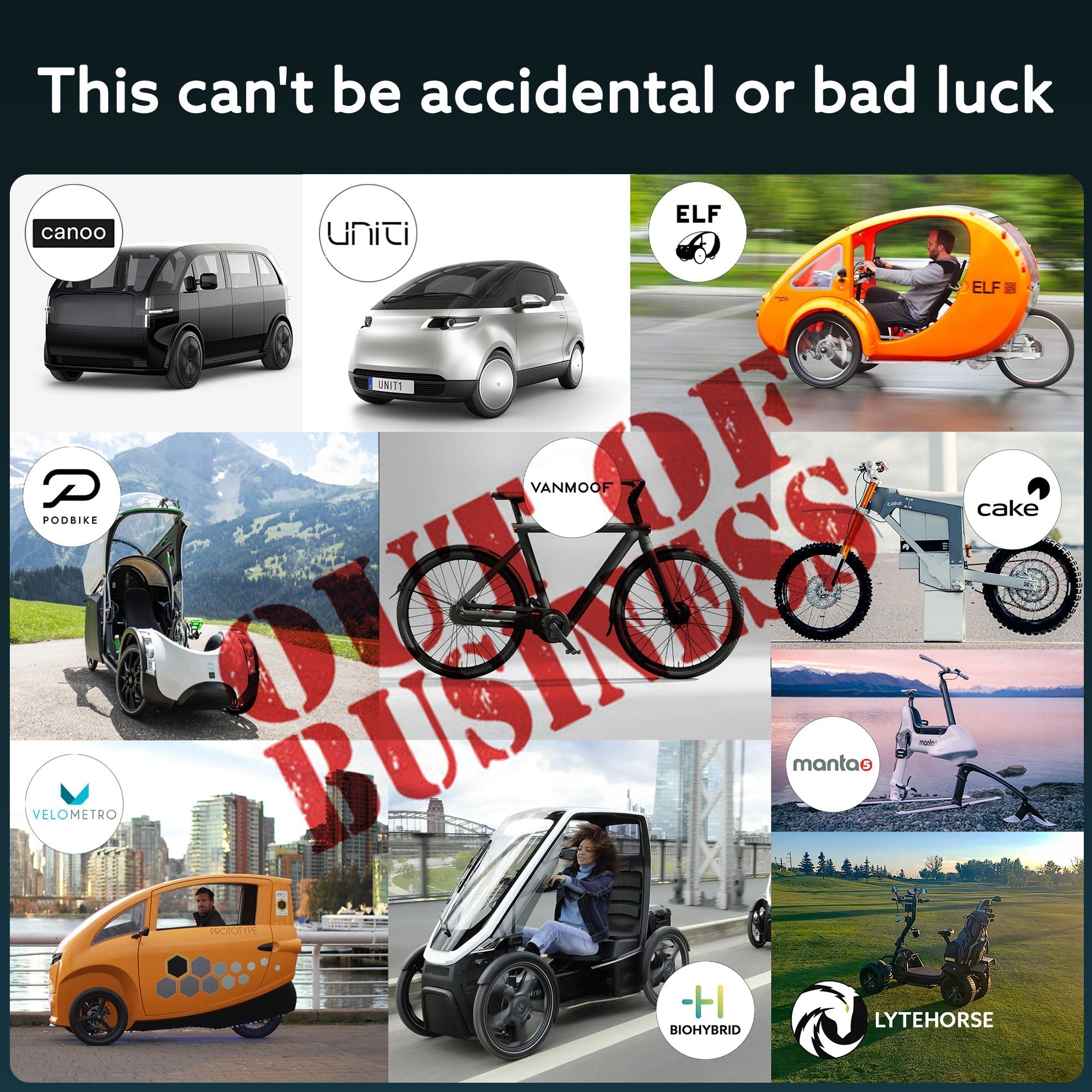
Take a close look at this image.
Every single company featured here, Canoo, Uniti, ELF, Podbike, VanMoof, CAKE, VeloMetro, BioHybrid, Manta5, LyteHorse, you name more, was once seen as a bold innovator in the micromobility or light electric vehicle space.
Now? Most of them are either out of business or struggling financially.
This isn’t just a coincidence.
They weren’t lacking creativity, engineering talent, or even market interest.
So what went wrong?
Our sector has faced significant challenges, including poor unit economics due to high costs and low margins, compounded by hardware losses. Regulatory hurdles, low user retention beyond initial novelty, and substantial capital and operational expenditures further complicate the landscape. Weak infrastructure support, overestimated demand, unsustainable business models (often reliant on subsidies), hardware fragility, and seasonal usage fluctuations have all played a role. Finally, a “scale-first” approach, often driven by venture capital, sometimes preceded achieving true product-market fit.
If I had to distill what I’ve learned so far, I’d name these as the three biggest patterns of failure I’ve seen:
1. Mismatch Between Niche Product and Mass-Market Expectations
Mini or micromobility solutions are designed to bring efficiency or unique features to specific mobility use cases. This often comes at the cost of versatility when compared to traditional vehicles like cars, SUVs, and trucks, automatically placing our solutions in a niche market.
Traditional investors frequently confuse micromobility with automotive-scale opportunities, overexpecting mass-market behavior after product development. Meanwhile, many of us are building mobility startups like software ventures due to the influence of VC investors, overlooking the immense complexity of scaling hardware production, supply chains, and logistics.
2. Overengineering With Low Production Efficiency and Scalability in Mind
Very few of us, as inventor-founders or engineer-led teams, can overcome the arrogance of textbook business planning. We often ignore the fact that markets and human behavior are far less predictable than engineering phenomena.
We tend to overfocus on product development while underinvesting in a holistic roadmap for commercialization and business development. Many of us believe that once a perfectly engineered, innovative solution is launched, the market will naturally catch on. It rarely does.
3. Public Excitement ≠ Real Adoption
We often forget that mobility is inherently “sexy”, but that charm doesn’t automatically translate into people spending thousands to own a product.
This trap isn’t limited to us as founders; investors at all levels fall for it. When investments move into the public eye through crowdfunding or IPOs, things can quickly get illogical. Some of us may capitalize on this illusion, like Tesla trading at a ~200 P/E ratio. But others crash hard.
Arcimoto hit a $1.5B market cap in 2022, equivalent to the value of 70,000 units of its FUVs. Can we realistically imagine multiplies of that number being sold in a realistic market texture?
Manta5 created one of the most viral public campaigns in mobility history. The product was undeniably cool. But tens of millions of organic impressions and public praise didn’t translate into enough sales to sustain a minimally viable business.
What Are Success Benchmarks ?
Let’s agree that a long-lasting mobility product, company, or brand can be perceived as a success and review a few scenarios.
1. Non-Innovative or Commodity Product Brands
In today’s market, we see a lot of congestion in the e-bike and e-scooter segments, which benefit from mature mass production and supply chains rooted in Asia (mainly China and Taiwan). Many of these brands have been around for quite a while and have found good market traction. They're not focused on breakthrough innovation, instead, they work with proven concepts, competing on cost-efficiency and supply chain optimization to offer affordable products while maintaining margins.
While this might not be directly aligned with the topic of disruptive innovation, we can learn key lessons from these successes:
-
A. Versatility (as seen in e-bikes and e-scooters) leads to broader market appeal.
-
B. Real adoption comes from affordability.
-
C. Affordability is achieved through mass customization and shared supply chains (e.g., Shimano components, Bosch motors, Panasonic battery cells, or Chinese hydroformed frame manufacturers supplying hundreds of brands).
2. Cheap Innovative Toys (Made-in-China)
From backyard welders to small Chinese factories, we’ve seen a rise in mini Jeeps, e-ATVs, micro-cars, enclosed mobility scooters, e-hydrofoil boards, and other experimental products, often sold for a few hundred dollars on platforms like Alibaba. While not ideal in engineering or user experience, this business model works.
Even though future-shaping mobility solutions might not originate from such low-cost environments, there’s a lesson in scalable niche marketing. By leveraging global early-adopter channels and low-barrier distribution logistics, even high-ticket niche products can succeed.
We must design the product and business to sell to the niches in global scale.
3. What About Large, Established Brands?
There are exceptions, but most large and established brands, especially automotive giants, either don’t step into game-changing mobility, or they struggle when they do. Why? Because their business models are built around scale, and niche markets don’t meet their operational expectations. As if it makes more sense for them to fight for their automotive market share than to launch an entirely new product in an unproven category that starts from zero historical demand.
Those who tried, like Renault with the Twizy, may not see 30,000 units as a success compared to their scale. Large brands typically lack the adaptability needed for niche innovation unless they create ecosystems of acquired businesses, each focused on specific market segments, each happy with their small scale.
Some car companies have dabbled in e-bike product lines, but these often end up as awkward, white-labeled experiments, rarely as part of a coherent, long-term strategy.
4. Chinese Mobility Brands
Despite facing the same ups and downs of the micromobility industry, including COVID-related disruptions, vacuum and post-COVID oversupply, several large-scale Chinese producers such as NIU, Xiaomi (Ninebot), and Yadea have seen substantial growth in recent years. Their success is driven by strong domestic demand, cost-effective high-volume manufacturing, a global export strategy with regulatory compliance, smart tech integration, and diverse modular product lines with appealing design.
While international mobility manufacturers may not benefit from China’s regulated market and export government incentives, there are valuable lessons to be learned from their ecosystem-driven approach and modular business models that enable scalable growth.
What Is the Path to Success for Real Innovations in Mobility That Aim to Shape the Future?
It starts with an ecosystem approach rather than a product-based business model. We must build or become part of a product and business ecosystem. Our product idea doesn’t necessarily need to become a standalone business or brand; we can plug it into an existing, functioning business if possible.
A Few Guiding Principles:
-
Accept That Micro/Mini Mobility Will Remain Niche
Micro/mini mobility will likely continue to serve niche markets, but these niches come with deep requirements, manufacturing, logistics, sales, support, marketing, technical services, liability coverage, and localized operations.
We must ask ourselves: how much of this are we realistically prepared to take on alone to build a sustainable business?
-
Avoid Vertical Integration for the Sake of Control
We shouldn’t hesitate to outsource. Our parts can be made in other factories or countries. We shouldn’t get trapped in the illusion of politically correct supply chains, these slogans don’t apply to niche products. We don’t need to fabricate our own frames; hundreds of factories can manufacture our components or even assemble our final product.
Third-party logistics companies can do things ten times more efficiently than a small in-house operation. Even engineering tasks can be outsourced to specialists.
We should leave margin for resellers; let them be part of our sales engine. We must focus on what we do best and not overstretch.
-
Embrace Modularity and Mass Customization
If our single-SKU product hasn’t reached volumes that make it affordable and competitive, then we must integrate generic, mass-produced components wherever possible.
We should leverage existing supply chains instead of overengineering with ambitious, proprietary features, as long as our unique value proposition is preserved. In other words, we must adapt our innovation to work with off-the-shelf components or platforms already used in other mass-market products.
-
Bootstrap with Purpose
The market needs new mobility solutions, but maybe not at the scale we or our investors imagine.
We should identify low-hanging fruit among early adopters. Design, build, and deliver an MVP to them. These users will become our most trusted investors, they won’t pull the plug like VCs can.
A smaller market means a lower cost to enter and sustain.
We must find the optimal business size with minimal cash investment and stay as close to positive sales cash flow as possible.
If we can produce and sell 100 units profitably, we should stick to that instead of structuring a business for 100,000 units and massive capital rounds.
The pace of awareness and market adoption in mobility innovation aligns better with bootstrapping than with traditional VC or automotive-style ventures.
What We Believe at ENVO; Collaboration and Partnership Is the Road Forward
We didn’t know all of the above when we started, and we’ve failed many times, likely at least once for every principle listed here.
But today, we operate in a much more breathable atmosphere, and we have hope for a sustainable business in a newly emerging industry.
With the mission of “rightsizing mobility for a healthier community,” we believe we’ve found the secret sauce for a profitable and growing business model in sustainable mobility innovation.
Our modular product ecosystem is working within a growing, partnership-based organization, rather than one built purely on traditional employment.
We're open to sharing and expanding this ecosystem with like-minded founders, innovators, investors, manufacturers, brands, and startups who share our vision, mission, and values, with the goal of building the future of mobility safely and with a greater chance of success, together.
Share:
ENVO UPT: A new industry approach for specialized light mobility.
The Revolution Will Not Be Streaming Live. It’ll Be Rolling Past You at 32 km/h.
1 comment
Very interresting article… made me remember the time I was following the 3-wheeled Sondor electric car project… then the Metacycle (is it what it was called ?)… the micro-electromobility was having a hard time since a while ago, it seem….