

Every company has a founding myth. ENVO's isn't a Silicon Valley garage or a venture pitch deck. It starts in Iran, in 1998, with a university engineering team, a national competition, and a vehicle nobody had asked for yet — but that turned out to predict everything that followed.
The University Project That Started Everything
In 1998, Ali Kazemkhani — who would later found ENVO — was part of an engineering team at university tasked with building a human-powered vehicle (HPV) to compete in a national competition. The challenge was straightforward in concept: design and build a vehicle powered entirely by the rider, engineered to be efficient, safe, and practical.
What the project actually demanded was far more complex: structural design, drivetrain engineering, ergonomics, weight optimization, and a working understanding of how humans interact with machines under physical load. For a student team with limited resources, the constraints were the curriculum.


Ali and the university team with their human-powered vehicle, built for a national engineering competition — 1998, Iran.
That 1998 HPV project wasn't just a student exercise. It was the first time the core question was asked: how do you move a person efficiently, practically, and at low cost — using the best available engineering rather than the default solution?
The team competed. The vehicle worked. But more importantly, the process of building it established habits of thinking that never went away: design around the actual use case, reduce unnecessary weight, keep the system serviceable, and don't accept the first configuration that works when a better one is possible.
From Human Power to Electric Power
By 2001, that same engineering instinct turned toward a new question. Electric propulsion was becoming technically accessible — hub motors existed, batteries were improving — but the products in the market were either too expensive, too fragile, or too dependent on supply chains that didn't exist locally.
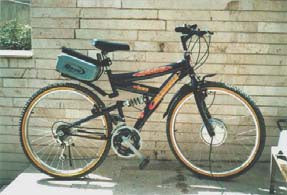
The first electric bicycle project began not as a business, but as an engineering problem: how to electrify a conventional bicycle using available components in a way that ordinary people could actually ride and maintain. The earliest prototype used a direct-drive hub motor paired with sealed lead-acid (SLA) batteries — the only accessible option at the time.


Early electric bicycle prototypes, 2001–2005. The silver step-through and the dual-suspension mountain bike represent two different conversion approaches tested during this period.
It worked — but riding it immediately revealed the limits. The battery weight was excessive, weight distribution was poor, climbing performance was weak, and range was short. The system proved the concept. It also made the problems undeniable.
What the Prototypes Taught
Heavy, inefficient, and poorly balanced. They worked in the lab but made the bike impractical for daily use. The path forward required lithium chemistry.
Poor low-speed torque and heat buildup under load. Geared hub motors delivered better efficiency and climbing performance at the cost the user could actually live with.
Different frame types required different solutions. Battery position, wiring architecture, and mounting all had to adapt. A rigid design didn't survive contact with reality.
A system too complex to maintain was a system that wouldn't be used. Wiring had to stay simple, components accessible, and failure modes understandable without specialist tools.
The Battery and Motor Evolution
Over the next several years, the platform matured. SLA gave way to lithium-ion, which dramatically improved energy density, weight, and range. Direct-drive motors gave way to geared hubs with better torque characteristics at lower speeds. Each iteration wasn't just a component swap — it was a deeper understanding of what the system actually needed to become a practical product.

Battery and motor assembly detail — showing the modular mounting approach developed across multiple iterations.
Ali and his university team design and build an HPV to compete nationally. The process establishes the foundational engineering thinking that persists through every ENVO product.
Direct-drive hub motor + SLA battery on a standard bicycle frame. Proof of concept confirmed. Weight, balance, and range issues identified immediately.
Platform evolves toward geared hubs and improved battery positioning. Multiple frame configurations tested. Modular mounting logic begins to take shape.
Li-ion batteries replace SLA, dramatically improving practicality. Commercial attempts begin locally — but market readiness, regulations, and economic instability prevent traction.
Despite a technically sound product, commercialization stalls. Regulatory changes, low market awareness, and economic instability make a stable business impossible. The product works. The market isn't ready.
A technically sound product alone is not enough. Commercialization requires infrastructure, timing, regulation, and market readiness. This was learned early — and it directly shaped how ENVO approached every market it entered afterward.
What Carried Forward
By the end of this chapter, there was no stable business — but there was something more durable: a repeatable engineering mindset and a clear set of hard-won principles.
Modular drive systems. Scalable battery thinking. Practical serviceability. Adaptation to different vehicle platforms. Designing with future evolution in mind. Every one of these principles first appeared in that early conversion project — and every one of them is still present in ENVO products today.
The same engineering instinct that built a human-powered vehicle for a national competition in 1998 eventually produced conversion kit programs, EbikeBC, the SnowKart, the Flex, and ENVO's broader electric mobility platform. The problems changed. The thinking didn't.
Built on 25 Years of Engineering.
ENVO e-bikes carry the lessons of every prototype that came before them — designed and supported in Canada.
Explore ENVO E-Bikes
Share:
Electric SnowKart Gen 1 - ENVO Drive Systems
ENVO D35: The Bike That Started Everything