

Before ENVO built its first complete e-bike, the company had spent years developing and refining electric conversion kits. Those kits taught the team a great deal about motor behavior, battery management, and what riders actually needed from an electric drivetrain. But they also revealed a gap in the market that no kit could solve.
Many riders who wanted to go electric did not own a bicycle worth converting. That single observation led directly to the D35, and to everything ENVO became as a product company.
Where It Began
The D35 project launched in 2017, once conversion kit sales had generated enough commercial traction to justify a more ambitious step. The goal was straightforward but difficult to execute: build a complete, practical urban commuter e-bike that could serve the widest possible range of riders at a price point that made sense for everyday use.
This was not a niche product. The first ENVO e-bike had to work for commuters, recreational riders, flat terrain and mild hills, tall frames and shorter ones. Getting that geometry right, integrating the electrical system cleanly, and building a reliable supply chain simultaneously was the central challenge of the D35 program.

The ENVO D-Series conversion kit: hub motor, battery, and display, the foundation the D35 was built on.
The Engineering Decisions
Battery placement was one of the first decisions with long-term consequences. The D35 used a downtube-mounted pack that kept weight low and centered, remained removable for charging, and could be serviced without specialized tooling. That choice became a standard across later ENVO platforms.
The electrical system itself was already mature before the D35 existed. Years of kit development meant the motor tuning, controller logic, and battery management were proven in real-world conditions. This gave D35 an advantage early e-bike startups rarely had: the drive system was not an experiment.
Motor, controller, and battery behavior were already validated through conversion kit use before the D35 frame was designed.
Neither aggressive nor overly upright. The D35 frame was tuned for daily commuting across a wide range of rider sizes.
Charging, servicing, and transport all required a removable pack. This constrained the design but simplified long-term ownership.
Frames, forks, drivetrains, wheels, and finishing parts all needed stable sourcing. Building that supplier network was one of the hardest parts of the project.
Spring 2018: Production
By spring 2018, D35 reached production. The result was a bike that worked well for the people who bought it, not because it was technically complex, but because it was well-matched to actual daily use. Reliable component choices, clean integration, and a competitive price point made it immediately relevant.

An early production D35 unit. Silver frame, Kenda tires, VELO saddle: practical and unsurprising by design.
ENVO refines hub motor kits, developing the battery and controller logic that will underpin the D35 electrical system.
The decision is made to build a complete e-bike. Frame geometry, battery placement, component sourcing, and supply chain development begin in parallel.
D35 reaches production and enters the market. Dealer conversations begin. The product finds acceptance quickly among urban commuters.
Step-through derivatives, updated D35 generations, and the foundation for the 50 Series all trace back to decisions made during the original D35 program.
What D35 Changed Structurally
The D35 did more than generate sales. It changed what ENVO was as a company. For the first time, ENVO could enter bike shop distribution, have real dealer conversations, and think about product line evolution rather than individual kit variants.
It also created the supply chain infrastructure that every subsequent ENVO bicycle depends on. Frame sourcing, quality control processes, and component relationships built during the D35 program carried forward into the step-through, the 50 Series, and later platforms.
The D35 succeeded not because ENVO invented something new, but because years of real-world kit experience informed every design decision. The electrical system was already right before the bike existed. That is a structural advantage most first-generation e-bikes do not have.

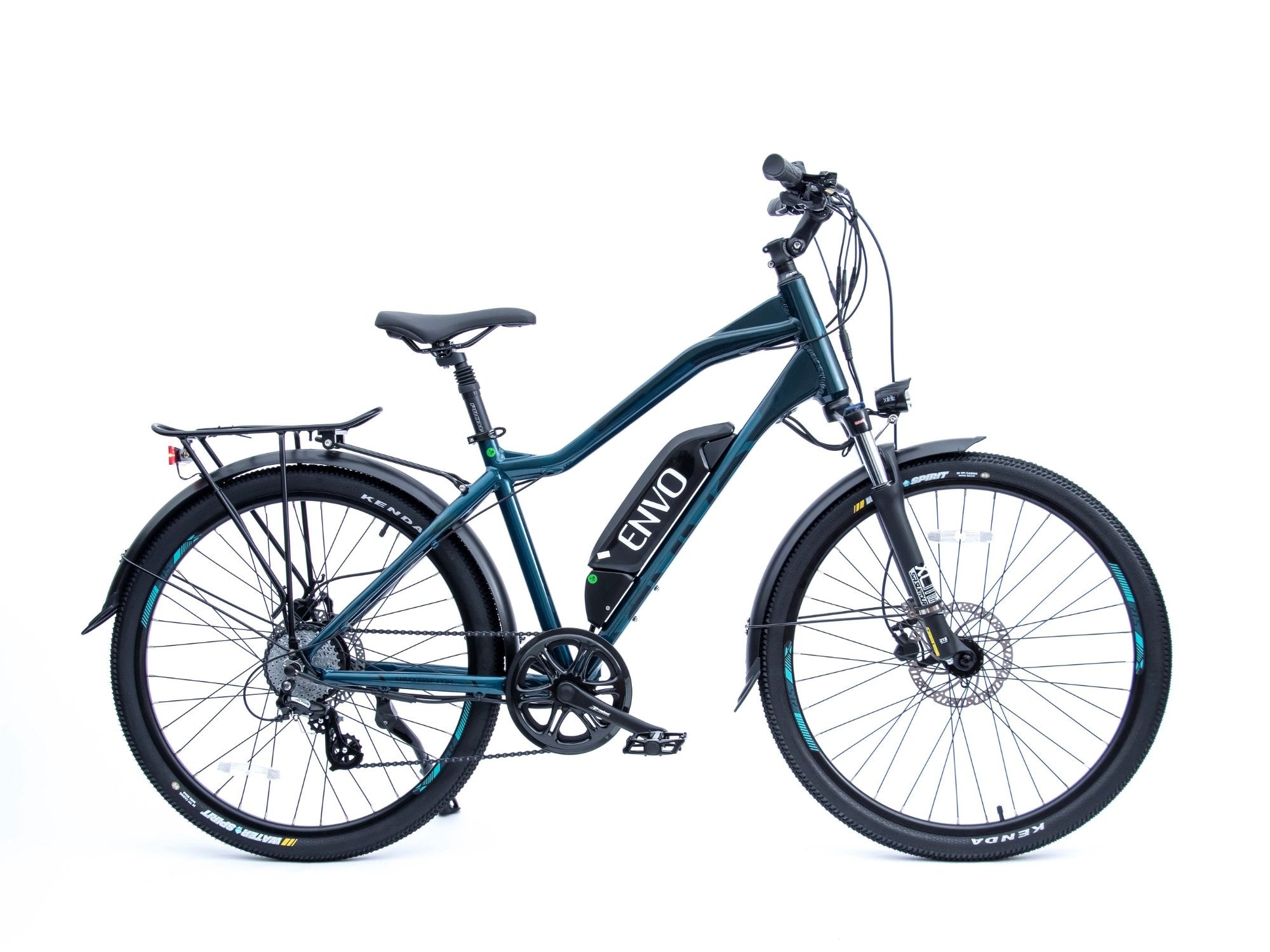
The current D35 generation in Galactic finish. The geometry and drive philosophy trace directly back to 2017.
The Legacy
D35 became the origin point for multiple later generations, step-through derivatives, and the STAX platform concept. Almost every major ENVO bicycle platform that followed shares DNA with the original 2017 program: the battery format, the motor integration approach, the geometry philosophy, and the supply chain architecture.
It also proved something less obvious: that a company built on systems thinking can make the transition to complete products without losing engineering discipline. The D35 was commercially successful because it was designed right, not because it was marketed aggressively.
See It In Motion
The D35 story is best understood through riding. Here is a look at the D35 in real-world conditions.
Is D35 Is Still Here?
Eight years on, the D35 platform continues to evolve. Designed and supported in Canada.
Explore the Successor
Share:
Where It All Began — ENVO
ENVO SnowBike Conversion Kit — The Second Universal Mobility Idea