

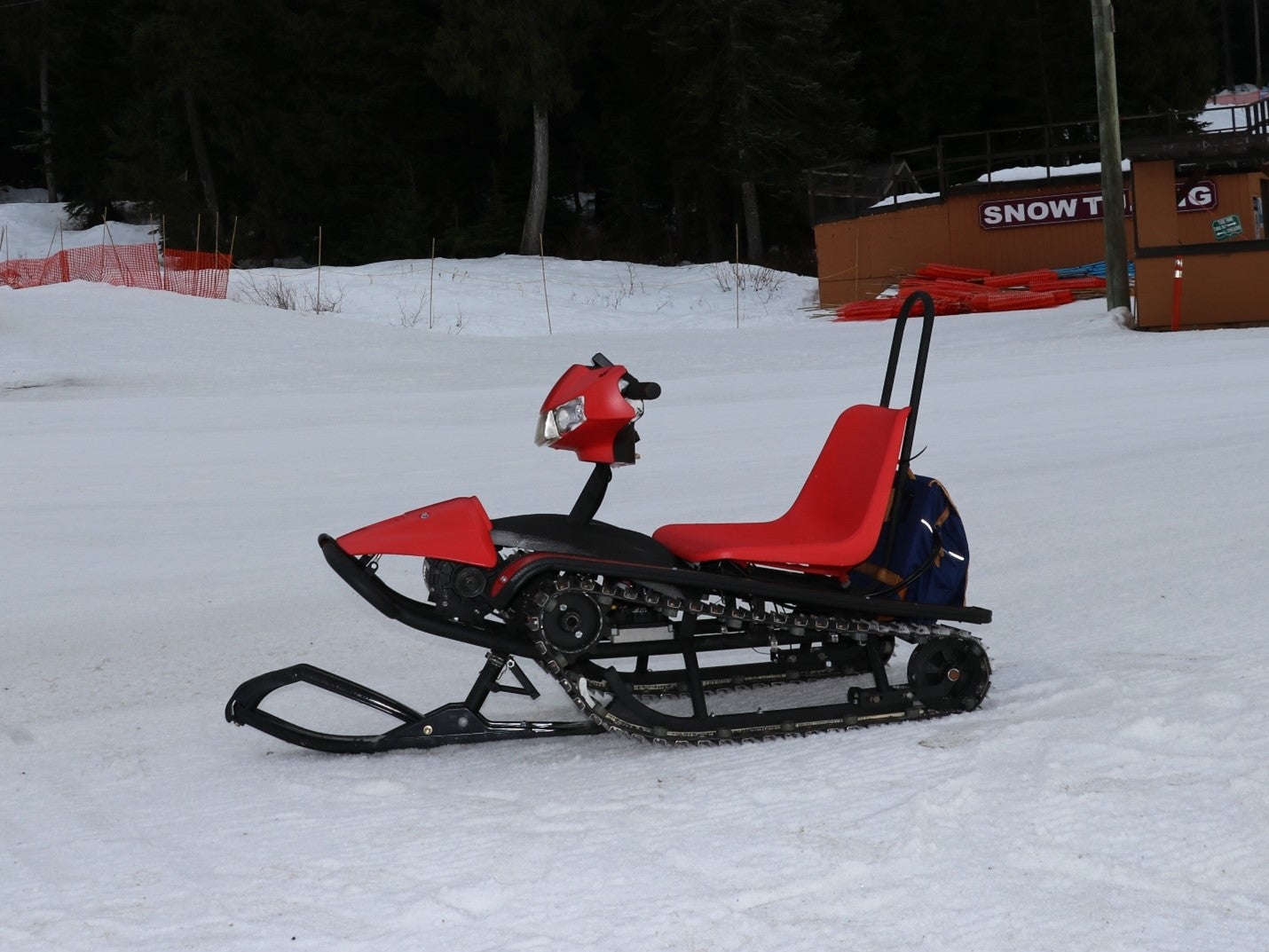
Nearly two decades after the original SnowKart experiments proved that a lightweight tracked snow vehicle could work dynamically, the concept returned - this time under very different technical conditions. By 2017, the question was no longer whether the idea was sound. The question was whether electric propulsion could finally make it practical.
Canada spends roughly six months of the year under snow and ice, covering 80% of its landmass. Yet personal snow mobility hadn't changed meaningfully in decades. That's the gap the Electric SnowKart was built to address.
The Right Time for the Idea
eBikeBC was maturing as a business by the mid-2010s, and it created space to invest in longer-horizon R&D. Several conditions converged to make the SnowKart worth revisiting:
Li-Ion cells - commercialized through EVs and eBikes - had become safe, energy-dense, and affordable enough to build a compact custom pack with real usable range.
Hub motors and BLDC systems had matured. Eliminating the combustion engine meant fewer moving parts, no fuel handling, and instant torque - all relevant to snow conditions.
Years of working with electric bicycle drivetrains, battery integration, and modular chassis design gave the team a practical foundation to build from - not just a blank-sheet concept.
Snow mobility that's quiet, emission-free, and accessible - for recreation, resort use, or light utility - had no real product equivalent in the market.
Ali Kazemkhani, leading ENVO Drive Systems in Canada, revisited the SnowKart concept with a focused question: could the same lightweight dynamics proven in earlier gasoline prototypes be reproduced - and improved - using an all-electric platform?
Electric SnowKart Gen 1 - 2017
The first modern electric SnowKart was built in Canada in 2017 as a proof-of-concept. The objective wasn't to reproduce the earlier gasoline design. It was to test a specific set of parameters together for the first time.


Frame assembly underway in the ENVO workshop - each tube joint and mounting point designed around the electric drivetrain architecture.
The Gen 1 platform used a fixed welded steel tube frame with two rear tracks on a fixed axle and a single front ski for steering. The drivetrain was built around a 3 kW rated central BLDC motor running at 72V, with belt drive synchronization to the rear axle.

The belt-drive system connecting the BLDC motor to the rear axle - designed for synchronization without chain slap or chain lubrication requirements in cold conditions.
The Engineering Choices
Each major system in the Gen 1 required original engineering work. Off-the-shelf components existed for parts of the problem, but the snow-specific integration required custom development.
Each track consisted of 48 U-section stainless steel blades bolted to two rubber-polyester belts. Sprocket geometry - including the involute curve profile - was designed to guarantee track position without slip or excess noise.
Material selection for both sprocket and blade, and the involute tooth profile, were primary engineering challenges. The goal was positive track engagement under load without damage to the belt system.
A centrally mounted QS 3000W 72V BLDC motor paired with a VOTOL EM-100 controller. Centrally mounted to keep the center of mass low and symmetric relative to the track width.
Two 72V 16Ah modules wired in parallel, built from LG MH1 3200mAh cylindrical cells. The custom pack provided 2.3 kWh of usable energy in a compact, low-profile form factor suited to the chassis.


Left: custom cell packs during assembly, using LG MH1 cylindrical cells. Right: finished 72V battery modules ready for integration.

Gen 1 complete and lit up in the workshop - the red bodywork and integrated headlight giving the machine a finished appearance despite still being a prototype.
On Snow - What Worked

Gen 1 on snow at a local resort - the low-slung seated position and wide track stance visible in the field.


First rider tests: low center of gravity and track width produced stable behavior on groomed surfaces. Track imprints in fresh snow confirmed consistent contact patch pressure.
Track traction performed well across varying snow conditions. The steering geometry - a single rigid ski up front combined with the fixed rear axle - proved intuitive at the speeds the machine operated. The performance-to-size ratio met the original targets, and the machine drew immediate interest from anyone who saw it in motion.

Gen 1 at speed - the machine demonstrated that the core dynamic concept worked. What needed refinement was everything around it.
What Didn't Work
Honest prototype reporting matters more than highlight footage. The Gen 1 surfaced clear failure points that defined the development agenda for everything that followed.
Balance and stability on uneven terrain were problematic. The steel blade track design posed a safety risk and was not suitable for a commercial product. Drivetrain loading under hill resistance exposed transmission reliability limits that needed to be resolved before the machine could be trusted in regular use.
The machine handled compact and groomed snow acceptably. Deeper or softer snow revealed that traction consistency, drivetrain loading behavior, and cold-weather energy efficiency all needed further work. Electric propulsion solved the emissions and noise problem, but it didn't automatically solve the snow contact mechanics problem. That was the central learning.
The electric SnowKart concept was viable. The platform architecture was sound. What Gen 1 confirmed - clearly - was that snow contact mechanics and drivetrain reliability under resistance were the engineering problems that would determine whether the product could ever be commercially practical. That's exactly what the next generation was built to address.
What Gen 2 Was Built to Fix
The Gen 1 results translated directly into a development checklist. None of the findings were surprising - they were exactly the kind of first-prototype data that makes the second iteration meaningful.
Steel blade track elements were a hazard. Gen 2 required a fully enclosed, safe track system suitable for use around people.
The belt drive system needed to handle hill loading and variable resistance without failure - a core requirement for any real-world use case.
Fixed axle geometry limited adaptability on uneven terrain. Active or geometry-adjustable suspension became a priority for the next platform.
Custom battery packs and motor selection needed to be re-evaluated against total system weight and target price point for a viable commercial product.
The first generation of the Electric SnowKart did what a first prototype is supposed to do: it answered the core feasibility question and revealed the real engineering problems. Both outcomes were necessary before the real product development could begin.
The SnowKart Story Continues.
From bench prototype to snow-tested platform - follow the ENVO SnowKart development journey and see what came next.
Explore ENVO Snow Vehicles
Share:
UPT: A Game-Changer in Wildfire Management
Where It All Began — ENVO