

There are products, and then there are ideas. ENVO's SnowBike Conversion Kit, developed between 2018 and its public release in 2020, was the second kind. It didn't just create a new product category. It extended a core engineering philosophy that had shaped ENVO from its earliest days.
The central question was simple: could a snow drivetrain be made universal enough to attach to an existing bicycle, rather than requiring an entirely new vehicle? That question changed everything about how ENVO thought about winter mobility.
The Engineering Question That Started It
After the second-generation electric SnowKart reached technical maturity, one design observation kept surfacing: the rear snow drivetrain was compact and self-contained enough to potentially work outside the SnowKart chassis entirely.
The key insight came from an integrated sprocket-based hub motor concept developed during SnowKart powertrain work. By combining propulsion and sprocket function into a single compact unit, the motor could interface directly with a snow track without requiring a large, purpose-built frame around it.
That observation reframed the whole project. If the drive unit was small and self-contained, it didn't need to belong to a dedicated vehicle. It could attach to a bicycle.

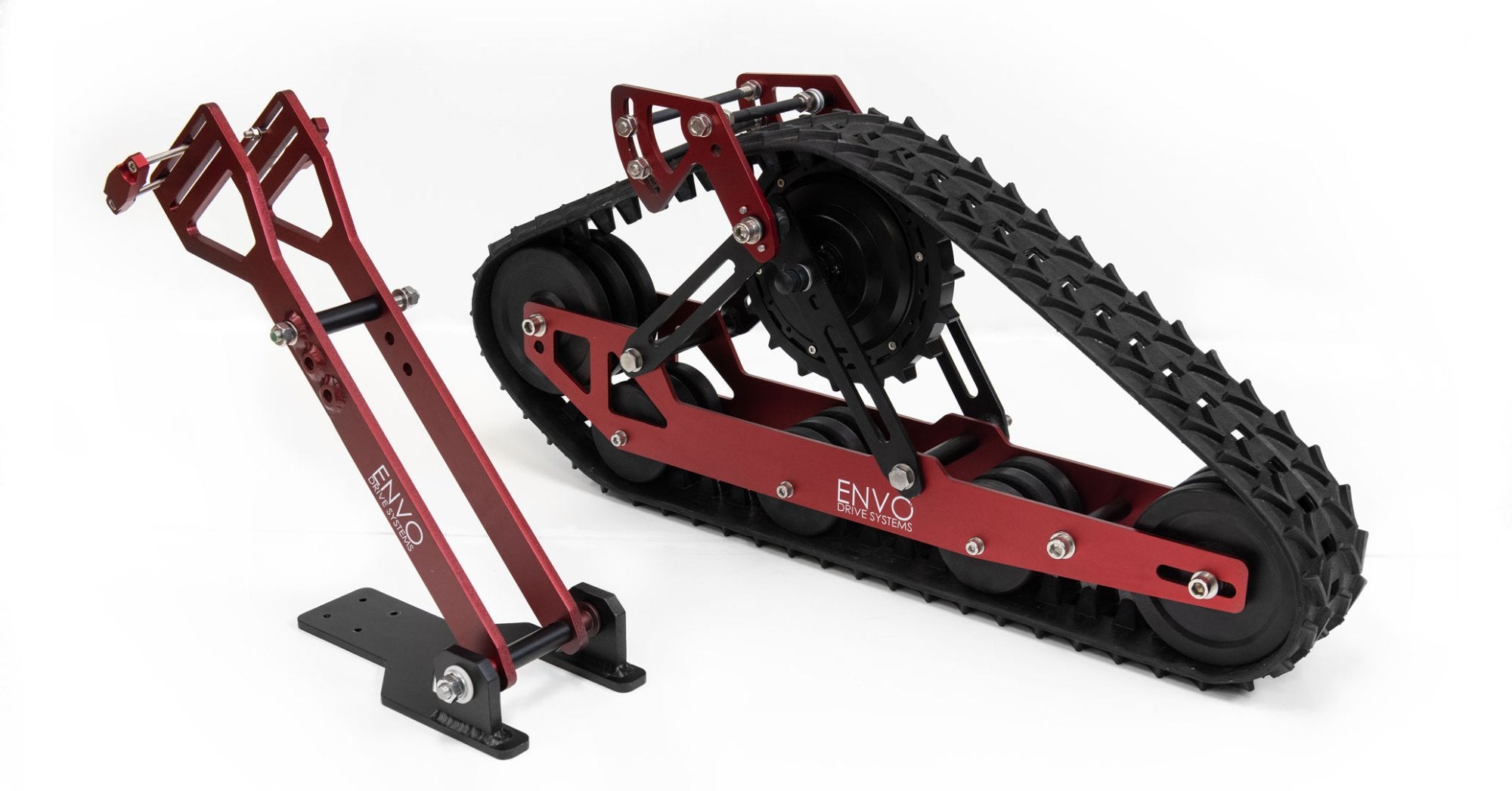
The two core conversion components: rear snow track module (with integrated drive) and front ski fork adapter.
What the Kit Actually Is
The SnowBike Kit converts an existing bicycle into a functional snow machine using two primary modules:
An electrically driven track assembly that replaces the rear wheel. The integrated hub motor interfaces directly with the track drive sprocket, keeping the drivetrain compact and the installation compatible with standard bicycle rear dropouts.
A ski-equipped fork assembly that replaces the front wheel. The anodized aluminum fork accepts a snowboard-style ski, providing steering control on snow. Adjustable geometry accommodates different bike frame heights.
The chain interface between the bicycle's existing drivetrain and the track module was one of the most demanding aspects of development. Unlike SnowKart, which used a fully custom chassis, SnowBike had to respect whatever bicycle geometry it was installed on. That meant the rear module had to work with standard bicycle dropout spacing and drivetrain layouts across a range of frame types.

Track module dimensions: 907mm length, 448mm total height, 155mm width. The integrated drive sprocket sits at the drive end of the track assembly.
Prototype Development: 2018
The first prototype was built in 2018 by Ali Kazemkhani, Tushar Patel, and Hari Bhati. Every system in the kit affected every other: track geometry, frame compatibility, drivetrain alignment, chain routing, motor torque delivery, steering balance, and snow traction behavior all had to be solved together, not sequentially.
Early prototype testing: the SnowBike in snow conditions, showing track traction and steering behavior.
The front ski fork presented its own geometry challenges. Bicycle fork rake and trail are calibrated for a round wheel, not a ski with different contact dynamics. Getting the steering to feel predictable on snow while still fitting a wide range of fork sizes required careful adjustment logic built into the mounting hardware.

The front ski fork uses a standard snowboard binding pattern, making the ski itself replaceable and accessible.
Further testing showing the complete SnowBike setup in real snow conditions.
Why Modular Was the Right Model
Previous snow vehicle concepts, from multiple manufacturers, had struggled commercially for a consistent reason: they required buyers to purchase an entirely new dedicated machine for a seasonal use case. The capital cost was high, the storage problem was real, and the justification for most buyers didn't hold up.
ENVO's approach inverted that logic. Instead of selling a new vehicle, the kit converted one the customer already owned. The bicycle became the platform. The snow modules were the seasonal layer.
A bicycle owner could extend their existing asset into winter use rather than buying a second vehicle. That made the economics of snow mobility accessible to a much wider range of buyers, and it made ENVO's kit directly comparable to a seasonal accessory rather than a capital purchase.
Assembly and Installation
The kit was designed to be installed by the rider, not a mechanic. The process involves removing the front wheel and rear wheel, mounting the track module to the rear dropouts with the chain connection to the existing drivetrain, and installing the ski fork in place of the standard fork.
Full SnowBike Kit assembly walkthrough: showing the complete installation process from standard bicycle to snow-ready configuration.

The complete kit installed: rear track module with electric drive, front snowboard ski fork. The bicycle frame, battery, and controls remain unchanged.
Its Place in ENVO's History
The SnowBike Kit was the second time ENVO expressed the same foundational idea that had produced the original electric bicycle conversion kit: take something people already own and make it more capable through a modular system, rather than replacing it with something new.
That pattern later appeared again in FLEX modular systems, shared battery architecture, and the UPT platform. The SnowBike was the project that confirmed the direction was repeatable. A snow module that could serve multiple vehicles pointed directly toward the question that followed: could a single chassis serve multiple vehicle categories entirely?
First expression of the universal modular philosophy: convert an existing conventional bicycle into an electric vehicle through a bolt-on system.
Second universal modular mobility concept: snow drivetrain compact enough to attach to a standard bicycle frame, with integrated sprocket motor as the enabling technology.
SnowBike Kit reaches market as one of ENVO's first true snow mobility products available beyond prototype stage. Establishes modular snow conversion as a viable commercial model.
SnowBike's success as a modular concept feeds directly into FLEX, shared battery systems, and UPT platform architecture. The kit proved ENVO's direction was becoming platform-based, not product-by-product.
The SnowBike Conversion Kit holds a specific place in ENVO's innovation record: first integrated sprocket motor snow application, first modular bicycle-to-snow conversion system, and the direct conceptual bridge toward the platform thinking that now runs through everything ENVO builds. It is a product that mattered less for what it sold and more for what it proved.
Built on a Platform. Not a Promise.
ENVO products are engineered to work together and last. Explore what modular mobility means in practice.
Explore ENVO Products
Share:
ENVO D35: The Bike That Started Everything
The First SnowKart: ENVO Origin Story