

On June 24, 2026, the U.S. Consumer Product Safety Commission (CPSC) published a Notice of Proposed Rulemaking (NPR) that, if finalized, would fundamentally change how lithium-ion batteries in micromobility products are regulated in the United States. For most of the industry's history, the safety standards that govern e-bike and e-scooter batteries have been voluntary. This proposed rule would make them mandatory, add several new test requirements on top of the existing standards, and pull the entire electrical system of these products into a federal consumer product safety standard.
This is a long, technical document (66 pages in the Federal Register, from page 38162 to 38227), and most of the coverage so far has summarized it in a paragraph or two. That is not very useful if you actually design, source, certify, or import these products. This article goes into the detail: what the rule covers, which standards it locks in, the exact test modifications the CPSC is proposing, the incident data driving it, and what a manufacturer or importer needs to start doing now.
The short version: the CPSC proposes a new 16 CFR Part 1265 that would require the electrical systems of micromobility products to comply with three existing UL standards (UL 2849, UL 2272, and UL 2271), each with modifications, and would add micromobility products that are children's products to the third-party testing list in 16 CFR Part 1112. Written comments are due August 24, 2026.
The Document At a Glance
This NPR is issued under the CPSC's own general authority in the Consumer Product Safety Act (CPSA), specifically sections 7 and 9. It is not issued under the "Setting Consumer Standards for Lithium-Ion Batteries Act," a separate bill that has been pushing for exactly this kind of mandatory standard. That bill passed the House in 2024 but was never enacted, and has since been reintroduced in the current Congress as H.R. 973 and S. 389. The practical takeaway: the CPSC is not waiting for that legislation. It is moving under the authority it already has.
Why the CPSC Acted Now
A rule like this has to clear a legal bar. Under CPSA section 9, to issue a final rule the Commission has to find that the standard is reasonably necessary to eliminate or reduce an unreasonable risk of injury. The NPR builds that case on incident data pulled from the CPSC's own databases, the Consumer Product Safety Risk Management System (CPSRMS) and the National Electronic Injury Surveillance System (NEISS), extracted on November 1, 2024.
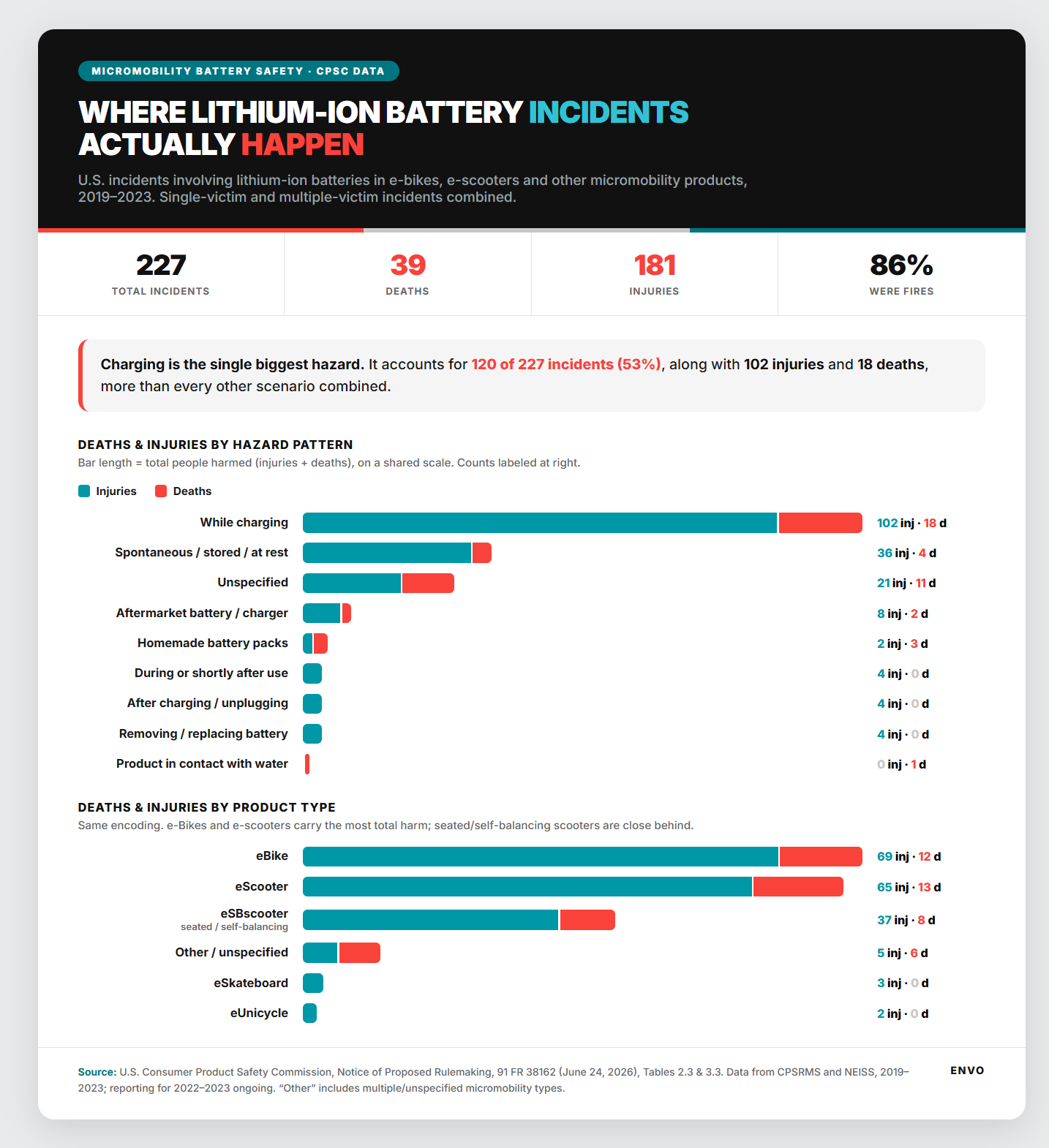
Across the five-year window from January 1, 2019 through December 31, 2023, the CPSC identified 227 unique incidents involving lithium-ion batteries in micromobility products. Ninety of those incidents were associated with 39 fatalities and 181 injuries, and 39 incidents involved multiple deaths or injuries. The remaining 137 were non-injury incidents. Fires dominate the picture: 195 incidents (about 86 percent) were fires, and those fires account for all 39 deaths and 174 of the 181 injuries. The Commission also notes that reporting for 2022 and 2023 was still ongoing, so the counts are likely to rise.

Just as important as the totals is where the failures happen. The CPSC groups the incidents into a set of hazard patterns, and these patterns map directly onto the test modifications the rule proposes. This is the connective tissue of the whole document: each identified failure mode is tied to a specific requirement.
By far the largest pattern. Failures during charging, often while the product is unattended, sometimes against the manufacturer's instructions. This is why so much of the rule targets charge control and the behavior of the battery management system (BMS).
Failures during storage or while the product is simply sitting idle, not charging and not in use. These point to latent cell defects and internal faults that a well-designed pack and BMS should detect or contain.
Incompatible or non-original chargers and replacement packs. This is the direct rationale for the new reverse-polarity and charger-compatibility requirements, and for tighter labeling.
Small in count but disproportionately deadly. Self-assembled packs, often from salvaged cells, with no BMS or protection. The rule cannot regulate these directly, but it targets them through enhanced warning labels.
What Products Are Covered
The scope is defined by product type and by which parts of the product are regulated. On product type, the rule covers six categories of micromobility products within CPSC jurisdiction (that is, excluding anything that falls under NHTSA's motor-vehicle authority):
- eBikes, defined as a two- or three-wheeled electrical/mechanical device with functional pedals, where an electric motor assists or powers the wheels.
- eScooters (standing scooters with a handlebar).
- eSBscooters (seated or self-balancing scooters).
- eSkateboards.
- eUnicycles.
- Hybrids of the above.
The last five categories are grouped in the standards world as Other Micromobility Products (OMPs), or "personal e-mobility devices": a consumer mobility device intended for a single rider with a rechargeable electric drive train.
On the "which parts" question, this is where the title's second half matters. The rule does not just regulate the battery cell. It regulates the micromobility electrical system, which the CPSC treats as an integrated safety system. That includes:
- The lithium-ion battery pack, both factory-installed (OEM) and user-replaceable.
- The battery management system (BMS).
- Chargers, both original and aftermarket.
- The motor controller and the rest of the electrical components that bear on the identified hazards.
The definition of user-replaceable battery packs explicitly includes batteries sold separately from the product and components sold in eBike electrical-system conversion kits. If you sell conversion kits or standalone packs into the U.S. market, this rule reaches you, not just the complete-bike makers.
The Three Standards It Locks In
The rule does not write a new battery test standard from scratch. Instead, it makes three existing voluntary UL standards mandatory, matched to product type, and then modifies them. The specific editions matter, because incorporating a standard "by reference" freezes it at a named edition. If you are certifying to a newer or older revision, that is not automatically compliant.
| Product | Standard (edition) | Full designation |
|---|---|---|
| eBikes | UL 2849-20 | ANSI/CAN/UL 2849:2020, Electrical Systems for eBikes |
| OMPs (eScooters, eSBscooters, eSkateboards, eUnicycles, hybrids) | UL 2272-24 | ANSI/CAN/UL 2272:2024, Electrical Systems for Personal E-Mobility Devices |
| User-replaceable battery packs | UL 2271-23 | ANSI/CAN/UL/ULC 2271:2023, Batteries for Use in Light Electric Vehicle (LEV) Applications |
A useful way to think about the CPSC's technical assessment: it went through each standard section by section (scope and definitions, construction requirements, performance tests, marking and instructions), decided most of it was adequate, and then identified a small number of specific gaps. The rule closes those gaps by borrowing the strongest requirement it can find, usually from UL 2272-24, and grafting it onto the other two standards so that all three carry the same protection.
To make that concrete, consider the eBike performance requirements in UL 2849-20. The Commission preliminarily found the core performance section adequate. Section 26 (General) requires performance tests on representative electrical systems. Section 27 (Input Test) addresses the charging hazard directly: it requires that the input current to an eBike while charging a fully discharged battery not exceed 110 percent of the manufacturer-rated input. Tests stress the system under normal and abnormal operation and require it to stay within its specifications.
The Four Changes the CPSC Wants
This is the heart of the proposal. On top of mandating the three standards, the NPR proposes four categories of modification. Three are new or expanded test requirements; the fourth is labeling. Each one is tied back to a hazard pattern in the incident data.
Tamper-Resistant Enclosure
Take the tamper-resistant battery enclosure requirement that already exists in UL 2272-24 and add it to UL 2849-20 (eBikes) and UL 2271-23 (replaceable packs). The goal is to prevent casual consumer access to the internal parts of the battery pack, where opening the pack can defeat protections, damage cells, or enable unsafe repairs and rebuilds.
Ties to: homemade / rebuilt pack incidentsPost-Discharge Charge Test
Add the post-discharge charge test from UL 2272-24 to UL 2849-20 and UL 2271-23. In plain terms, this test confirms that the BMS refuses to charge the battery when the cell surface temperature is above the specified upper limit. It is a direct control on the most dangerous moment in the incident data: charging a battery that is outside its safe temperature window.
Ties to: charging incidents (120 of 227)Reverse Polarity Test
Add a reverse polarity test to all three standards. This verifies that connecting a charger with reversed connector polarity, the classic failure mode with mismatched aftermarket chargers, does not damage the battery pack. It hardens the pack against the exact scenario behind many aftermarket-charger incidents.
Ties to: aftermarket charger incidentsRevised Labeling and Warnings
Revise the labeling requirements in all three standards for every in-scope product. The enhanced safety messaging targets electric shock hazards, thermal runaway, the dangers of homemade batteries, and unsafe charging practices, addressing foreseeable use and misuse that the tests alone cannot design out.
Ties to: misuse, homemade packs, unsafe chargingNotice what the CPSC is not doing. It is not inventing a battery of brand-new tests. Its position is that the three standards are individually inadequate to eliminate or adequately reduce the risk because each is missing protections that another already contains, or because none of them fully address a given failure mode. The fix is selective harmonization: level all three standards up to a common floor, then add reverse-polarity protection across the board.
The Technical Thresholds Behind the Rule
The preamble is not the regulatory text, but it does spell out the physical thresholds the modified standards are built around. For anyone building, sourcing, or certifying a pack, BMS, or charger for the U.S. market, these are the numbers the rule is reasoning from.
| Parameter | Value referenced in the NPR |
|---|---|
| Electric shock threshold | ≥ 42.4 peak VAC or 60 VDC is treated as an electric shock risk |
| Safe cell surface temperature, charging | Typically 0 °C to 45 °C |
| Safe cell surface temperature, discharging | Typically 0 °C to 60 °C |
| Per-cell voltage window | Max charge typically ~4.2 V/cell; minimum typically ~2.5 V/cell |
| Charging input current (eBikes, UL 2849-20 §27) | ≤ 110% of manufacturer-rated input when charging a fully discharged battery |
| BMS role | Continuously measures and compares voltage, current, and temperature against the manufacturer's specifications, and acts (limits or stops charge/discharge) when limits are exceeded |
The through-line is that the BMS is the safety-critical component. Almost every modification is really a check on whether the BMS behaves correctly at the edges: too hot to charge, wrong charger connected, cells out of their voltage window. A pack that passes cell-level abuse tests but has a BMS that will still initiate a charge on an overheated cell is exactly the failure the post-discharge charge test is designed to catch.
Certification, Testing, and the Compliance Path
A mandatory CPSC standard is not just a design target; it comes with a conformity-assessment regime. Here is how the pieces fit together.
Certificates of conformity
Under the CPSA, products subject to a consumer product safety rule must be certified as compliant. For general-use products, that is a General Certificate of Conformity (GCC) issued by the manufacturer or importer, based on a test of the product or a reasonable testing program. A GCC has to accompany the product through the distribution chain and be furnished to the CPSC on request.
Third-party testing for children's products
Some micromobility products are children's products, and children's products carry a higher bar: third-party testing at a CPSC-accepted laboratory, plus a Children's Product Certificate. The NPR handles this by adding the new Part 1265 rule to the list in 16 CFR Part 1112, the regulation that specifies which rules require third-party testing. In practice, if a given model is determined to be a children's product, its electrical-system compliance will need to be demonstrated through an accredited lab rather than by self-certification.
What manufacturers and importers should do now
- Map your models to the right standard and edition: UL 2849-20 for eBikes, UL 2272-24 for OMPs, UL 2271-23 for replaceable packs. Confirm your existing certifications are to those exact editions.
- Close the four gaps proactively: tamper-resistant enclosure, post-discharge charge test, reverse-polarity test, and revised labeling. If your lab report predates these, plan supplemental testing.
- Pull your conversion kits and spare packs into the program: they are explicitly in scope.
- Check whether any model is a children's product, which changes your path from self-certification to accredited third-party testing.
- Read the actual regulatory text and Appendix A (the Commission's proposed findings) in the Federal Register, not just the summaries, before you scope any work.
Market and Cost Impact
The CPSC's economic analysis frames a large and fast-growing market, most of it supplied from overseas. The Commission counts roughly 179 firms that manufacture or supply eBikes, 81 firms supplying about 704 eScooter models, and 67 firms that manufacture or supply OMPs. Nearly all eBike batteries are manufactured overseas, and nearly all eScooters are imported from China or Taiwan, which means a great deal of the compliance burden lands on importers acting as the responsible party for the U.S. market.
The growth numbers explain the urgency. eBike unit sales grew at roughly a 31 percent compound annual rate from 2018 to 2024. eScooter units grew at about 9.8 percent annually over 2018 to 2021 with revenue growing far faster, and the OMP category was forecast to reach around 213 million dollars by 2024. The detailed per-unit cost estimates live in the CPSC staff briefing package (Tab A of the NPR briefing memo) rather than in the preamble body, but the direction is clear: for products already certified to the current UL standards, the incremental cost is the delta of the new tests and labeling, not a full redesign. For products not currently certified at all, the cost is meaningfully higher.
If a company is already building to UL 2849 or UL 2272 with a real BMS, traceable cells, and proper charge control, this rule is mostly a validation-and-documentation exercise: add a few tests, tighten labels, keep records.
If a company has been competing on price by skipping certification, this rule is an existential change. That is precisely the point. The incident data is dominated by exactly the uncertified, aftermarket, and homemade end of the market.
Timeline and How to Comment
This is a proposed rule, not a final one. The sequence from here is straightforward but not fast.
Comment Period (Open Now)
Written comments on the NPR (and on the Paperwork Reduction Act burden) must be received by August 24, 2026, filed to docket CPSC-2025-0012 at Regulations.gov. Anyone who wanted to make an oral presentation had to email the Office of the Secretary by July 24, 2026.
Review and Final Rule
The Commission reviews comments and decides whether to issue a final rule. To finalize, it must make the CPSA section 9(f)(3) findings that the standard is reasonably necessary and in the public interest. Appendix A of the proposal contains the Commission's preliminary findings.
Effective / Compliance Date
The NPR does not set a compliance date. That will be established in the final rule, typically as a period after publication (measured in months) after which products manufactured must comply. Plan for it, but do not assume a specific date yet.
If you are a manufacturer, importer, dealer, or standards participant, the comment period is not a formality. The exact editions incorporated, the phrasing of the modifications, the compliance timeline, and the treatment of conversion kits and legacy inventory are all still on the table. This is the window where technical input actually changes the text.
What This Means for the Industry
North American micromobility has spent a decade in a regulatory grey zone. Good manufacturers certified their batteries voluntarily because it was the right thing to do; the rest of the market was free to skip it, and a meaningful share of the fires, injuries, and deaths in the CPSC's data traces back to that uncertified tail, plus aftermarket and homemade packs. Cities responded first (New York City's requirement that e-bikes and e-scooters sold in the city meet UL standards is the best-known example), and now the federal government is proposing to set a single national floor.
For a brand that already treats battery safety as a core discipline, this rule is broadly welcome. It raises the floor to something close to what a responsible company already does, and it does so in a way that is hard to undercut on price. For the industry as a whole, it is a maturation moment: the point at which "is the battery certified" stops being a differentiator and becomes table stakes.
At ENVO, we have built toward UL-aligned batteries, real battery management systems, and traceable cell sourcing for years, because the failure modes of lithium-ion chemistry are genuinely serious and the consequences of getting them wrong are borne by the rider. We would rather the whole industry be held to that standard than compete against products that cut the boring, safety-critical corners. A national rule that closes the gap on charge control, charger compatibility, pack access, and labeling is, on the merits, a good thing.
Quick Reference Table
| Question | Answer |
|---|---|
| Who is issuing it | CPSC, under CPSA sections 7 and 9 |
| What stage | Proposed rule (NPR); comments due Aug 24, 2026 |
| New rule created | 16 CFR Part 1265 (plus amendment to Part 1112) |
| Standards made mandatory | UL 2849-20 (eBikes), UL 2272-24 (OMPs), UL 2271-23 (replaceable packs) |
| New test requirements | Tamper-resistant enclosure, post-discharge charge test, reverse polarity test |
| Also changed | Enhanced labeling on all three standards |
| Conversion kits / spare packs | In scope |
| Children's products | Require third-party testing via 16 CFR Part 1112 |
| Compliance date | Not yet set; will be fixed in the final rule |
Sources and Further Reading
- Primary sourceFederal Register, 91 FR 38162, "Safety Standard for Lithium-Ion Batteries Used in Micromobility Products..." (Document 2026-12749), published June 24, 2026
- DocketCPSC-2025-0012 on Regulations.gov (comment portal and posted comments)
- CPSCStaff NPR briefing package and decisional materials on the proposed micromobility battery standard
- StandardsANSI/CAN/UL 2849:2020; ANSI/CAN/UL 2272:2024; ANSI/CAN/UL/ULC 2271:2023
- Legislative contextSetting Consumer Standards for Lithium-Ion Batteries Act (H.R. 1797, 118th Congress; reintroduced as H.R. 973 / S. 389)
- ENVOShipping E-Bike Batteries in Canada and the US: A Guide to Class 9 Dangerous Goods Compliance
This article is a working explanation of a proposed federal rule for manufacturers, importers, retailers, and other industry participants. It is not legal advice, and it summarizes a 66-page document. Before making compliance decisions, read the primary source in the Federal Register and consult qualified regulatory counsel and an accredited test lab.
Built on the Boring Parts
ENVO designs, certifies, and supports e-bikes built around real battery safety: UL-aligned packs, proper battery management systems, and traceable cells. Explore the lineup.
Explore ENVO E-Bikes
Partager:
CUSMA Review July 2026: Why Canadian E-Bike Buyers Could Pay $500–$1,500 More After the Joint Review