

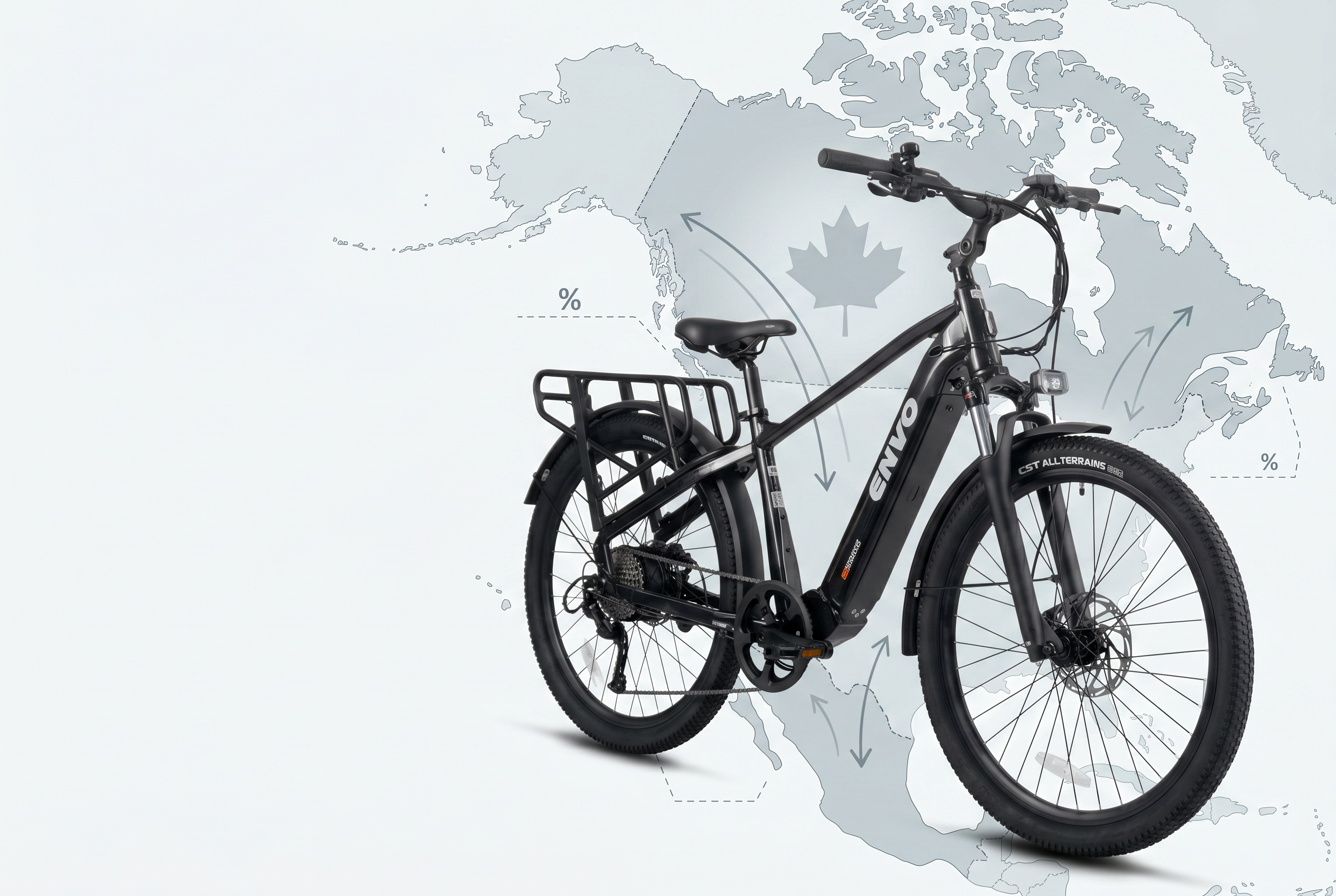
Most Canadian e-bike shoppers do not follow trade policy. They follow specs, ride quality, range, and price. But in July 2026, the three governments that signed the Canada–United States–Mexico Agreement (CUSMA) will sit down for the agreement's first mandatory joint review. The most consequential thing that could come out of that review for Canadian buyers is not what most consumers expect. It is not a new American tariff. It is a new Canadian one — specifically, a Canadian surtax on Chinese-origin e-bikes and components, imposed by Ottawa under direct pressure from Washington.
This is not speculation pulled from nowhere. It is a continuation of a pattern Canada has already established. In October 2024, Ottawa imposed a 100 percent surtax on Chinese-made electric vehicles and a 25 percent surtax on Chinese-origin steel and aluminum — explicitly framed by the federal government as alignment with US trade measures. The CUSMA review gives Washington its single largest piece of leverage to push that alignment further. E-bikes are an obvious next category.
If that surtax extends to lithium-ion cells, e-bike motors, or finished e-bikes under HTS 8711.60, the cost lands on Canadian retail prices — not US ones. The plausible range, based on how component pricing and rules of origin actually stack against an imported e-bike sold in Canada today, is $500 to $1,500 per bike. This article walks through how that mechanism works, what consumers and dealers can reasonably do about it, and where the genuine insulation exists in the Canadian market.
The Precedent: October 2024
On August 26, 2024, the Department of Finance Canada announced that Ottawa would impose a 100 percent surtax on Chinese-made electric vehicles and a 25 percent surtax on Chinese-origin steel and aluminum, effective October 1 of that year. The legal mechanism was an Order in Council under section 53 of the Customs Tariff Act, which gives the federal cabinet broad authority to impose surtaxes on imports from any country for trade-policy reasons.
The government's own statement on the measures was explicit. It cited alignment with the United States and the European Union, both of which had moved on Chinese EV imports earlier that year. The Canadian Press, Reuters, and Bloomberg coverage at the time all reported the same framing: this was Canada matching American trade posture, not setting its own.
What matters about the October 2024 precedent for the e-bike conversation is the mechanism, not the specific commodity. Section 53 allows Ottawa to add a surtax to almost any HTS line by cabinet order, without parliamentary debate. The October 2024 surtaxes were not in any of Canada's pre-existing trade legislation. They were introduced, consulted on briefly, and implemented within roughly sixty days. The same mechanism can extend to lithium cells under HTS 8507, to electric bicycles under 8711.60, to motors under 8501, or to any other line the government chooses — with the same speed and the same political framing.
How the Joint Review Becomes Leverage
CUSMA replaced NAFTA in July 2020. Article 34.7 of the agreement requires the three parties to meet on its sixth anniversary and confirm in writing whether they wish to extend the agreement for another sixteen years. If all three confirm, the next review is in 2032. If any one of the three declines, CUSMA enters a structured ten-year wind-down with annual review meetings, terminating in 2036 unless renewed earlier.
That mechanism was designed to put renegotiation pressure into the agreement that NAFTA never had. The practical effect for Canada is that the period leading up to July 2026 is the largest window of American leverage over Ottawa until the next cycle in 2032. Washington can credibly attach conditions to its confirmation. Several of those conditions have already been publicly discussed in US trade-policy circles. The condition most relevant to e-bikes is continued and expanded Canadian alignment on Chinese imports.
The political logic is direct. American legislators on both sides of the aisle have argued that allowing Chinese-origin goods to enter the United States through Canadian or Mexican supply chains undermines the purpose of US Section 301 tariffs. The October 2024 EV surtax was Canada's first major concession to that pressure. It is unlikely to be the last. The CUSMA review is exactly the moment at which Washington has the standing to ask for more — not just on EVs, but on the categories that have been moving quietly while the spotlight has been on cars.
Why E-Bikes Are an Obvious Next Target
The North American e-bike industry sits on a global supply chain. Battery cells come predominantly from China, Japan, and South Korea. Hub and mid-drive motors are concentrated in China, Taiwan, and Germany. Frames, controllers, displays, derailleurs, and most ancillary components originate in Asia, with the heaviest concentration in Chinese manufacturing centres. Final assembly is split across China, Vietnam, Taiwan, Mexico, the United States, and Canada.
Three things make e-bikes a natural candidate for a Canadian surtax extension. First, the direct overlap with the existing EV surtax category. Lithium-ion cell technology, battery management systems, and powertrain electronics overlap heavily between Chinese-made EVs and Chinese-made e-bikes. Officials looking for the next logical step from the October 2024 measure will see e-bikes as adjacent rather than separate.
Second, the low current Canadian duty. Most e-bikes entering Canada under HTS 8711.60 face a zero percent MFN duty today, regardless of country of origin. There is no existing tariff cushion. A new surtax adds directly to landed cost rather than replacing an existing one. That makes the price-impact pass-through faster and more visible than it would be in a category with established duty stacking.
Third, the thin importer margins. Canadian e-bike distributors and dealers typically work on 15 to 25 percent margins, and direct-to-consumer brands run on similar economics once warranty reserves and freight are accounted for. There is very little cushion to absorb a sudden five-to-twenty percent jump in landed cost. When costs rise on the manufacturer or importer side, the increase almost always flows through to the Canadian consumer within a single buying cycle.
How the $500–$1,500 Range Builds
The figure in the headline is a working range, not a forecast. It reflects how a Canadian surtax extension would actually flow through to retail prices on the typical e-bike sold in this country. The range is wide because the impact is highly brand-specific. A Canadian-assembled bike with regional sourcing and a North American supply chain will sit near the low end. A bike imported as a finished unit from China and rebadged for the Canadian market will sit at the high end, possibly beyond.
The mechanics, briefly:
- Finished-bike surtax pass-through. If Ottawa adds a surtax to Chinese-origin e-bikes under HTS 8711.60 at even a modest 15–25 percent rate, a $2,500 finished bike imported from China lands $375–$625 higher at the dealer. Most of that flows to the consumer.
- Lithium cell surtax pass-through. A 500–700 Wh battery pack contains $200–$400 of Chinese-origin cells at current pricing. A surtax on lithium cells alone, even on bikes assembled in Canada, adds $50–$150 to the bill of materials before margin stack-up. After margin, that is another $100–$300 at retail.
- Motor and component surtax exposure. Most Canadian-assembled e-bikes still source motors and controllers from Chinese suppliers. A surtax extension covering electric motors under HTS 8501 adds further to the bill of materials. Estimated retail effect: $100–$300.
- Currency volatility. CUSMA uncertainty consistently weakens the Canadian dollar against the US dollar. Canadian distributors paying USD-denominated invoices see immediate margin compression. Historical pattern: 3–6 percent of retail price across a review cycle, or roughly $100–$200 on a typical bike.
- Compliance and reclassification cost. Customs brokers, logistics providers, and importers face real administrative cost from new HTS lines, certificate-of-origin updates, and surtax declarations. Small per unit but real, and additive. Roughly $30–$100.
Stack the bands and the working range lands between roughly $500 at the low end and $1,500 at the high end, with most exposed Canadian-market bikes likely to see something in the middle. Bikes designed in California or Europe but fully assembled in China sit at the upper band. Bikes designed and assembled in Canada, with regional component sourcing wherever possible, sit at the lower band.
What This Means for Canadian Buyers
The practical implications for consumers are limited but worth understanding. There is no need to panic-buy in May or June. The review happens in July and any surtax decision flowing out of it will take months to implement — the October 2024 process from announcement to implementation was roughly sixty days, and the e-bike category would likely follow a similar timeline. Most brands hold three to six months of forward inventory, which insulates near-term retail pricing.
What does make sense is calendar awareness. If you have been considering a bike for the back half of 2026, pulling the decision forward by a quarter is a reasonable hedge. More important than timing is brand selection. The question worth asking every dealer or direct-to-consumer brand is straightforward: where is the frame manufactured, where do the battery cells come from, where is the motor sourced, and where does final assembly happen? The answer determines surtax exposure under any reasonable extension of the October 2024 framework.
“Made in Canada,” “Assembled in Canada,” and “Designed in Canada” mean different things and are used loosely across the industry. Ask the brand specifically where the frame, battery, and motor originate, and where final assembly happens. Surtax exposure will follow those facts — not the marketing.
Pricing volatility through the second half of 2026 is the more likely consumer-facing pattern: pre-review price holds, post-review adjustments brand-by-brand once any surtax order is gazetted, then a new equilibrium settling through the first half of 2027. Trading patience for price discovery is a legitimate strategy if you are not in immediate need.
What This Means for Canadian Dealers
For dealers, the implications are operational and immediate. Inventory planning for the back half of 2026 and the first half of 2027 needs to bake in the possibility of brand-specific surtax pass-throughs, supplier renegotiations, and floor-price volatility. The dealers who handle this well will already be having the conversation with their brand reps in May 2026, not reacting in August.
- Audit your inventory by surtax exposure tier. Map each SKU to country of frame manufacture, cell origin, and final assembly. Brands sit on very different rungs of the exposure ladder, and your purchasing decisions for the next two quarters should reflect that.
- Lock pricing where you can. For high-exposure brands, get pricing commitments in writing for as far out as the supplier will offer. Most brands will not commit beyond 90 days right now; that is itself useful information.
- Validate HTS classifications with your customs broker. Misclassification under a surtax order can mean retroactive duty assessments. The CBSA has been clear in past surtax cycles that the burden of correct classification sits with the importer.
- Pre-position inventory carefully, not aggressively. Frontloading inventory ahead of the review is tempting and, for some categories, sensible. But model-year rollover risk, carrying cost, and the possibility of a clean review outcome all argue against over-extending.
- Communicate with customers proactively. Canadian buyers will read the trade headlines and ask. Having a clear, sourced answer ready — the kind of working understanding this article tries to provide — is a competitive advantage in itself.
ENVO is a Vancouver-based company with engineering, design, and assembly operations rooted in Canada. Our supply chain has been built over a decade with regional sourcing where it makes sense, validated component partners, and a manufacturing footprint that is structurally less exposed to a Canadian surtax extension than a typical import-and-rebadge operation.
This does not make us immune. No e-bike brand in North America is fully insulated from global cell and motor sourcing. But the price-impact band we expect to operate within sits at the lower end of the $500–$1,500 range, not the upper end. Buyers comparing brands in 2026 should ask every manufacturer the same questions about origin and exposure.
Closing Note
Trade policy is one of those topics that feels distant until it lands in your wallet. For Canadian e-bike buyers, the CUSMA review is the moment when, for a lot of people, the distance closes. The framework is transparent, the timeline is known, the mechanism by which prices move — a Canadian surtax extension imposed under American leverage — is well understood, and there is genuine time to prepare on both the consumer and dealer sides.
The harder truth is that the conditions making the Canadian e-bike market vulnerable to this kind of price shock — concentrated Chinese component sourcing, thin importer margins, and a manufacturing footprint that still leans heavily on Asia — will not be solved by July. They will be reshaped by the review, possibly painfully, and the companies that come out of it well-positioned are the ones that have already invested in the harder, slower work of regional capability. That is the work we have been doing at ENVO for years, and the work we will keep doing regardless of how the review lands.
Quick Reference Table
| Mechanism | Trigger | Likely Retail Impact in Canada |
|---|---|---|
| New Canadian surtax on finished Chinese-origin e-bikes | Order in Council under section 53 of the Customs Tariff Act, post-CUSMA review | $375–$625 at typical retail; higher on premium imports |
| New Canadian surtax on Chinese-origin lithium cells | Same mechanism, HTS 8507 | $100–$300 on Canadian-assembled bikes that import cells |
| New Canadian surtax on Chinese-origin motors and components | Same mechanism, HTS 8501 and related | $100–$300 across most brands |
| CAD/USD weakening on review uncertainty | Currency markets, independent of surtax decision | $100–$200 per typical bike |
| Compliance and reclassification administrative cost | CBSA filing and broker work after any surtax order | $30–$100 per bike |
Sources and Further Reading
- Department of Finance CanadaSurtax Order (2024) on Chinese-made electric vehicles, steel, and aluminum — framing and implementation notes
- Customs Tariff ActSection 53 — surtax authority for Order in Council
- Global Affairs CanadaCUSMA implementation guidance and Article 34.7 (Joint Review and Extension)
- Canada Border Services Agency (CBSA)Customs Notices on HTS 8711.60 (e-bikes), 8507 (lithium cells), and 8501 (motors)
- Office of the United States Trade Representative (USTR)CUSMA/USMCA text and Section 301 tariff schedules on Chinese-origin goods
- Industry submissionsPeopleForBikes and BPSA trade-policy briefings on e-bike tariff exposure
Built on the Boring Parts
ENVO designs, certifies, and assembles e-bikes in Canada — with a supply chain built for the long haul, not the next policy cycle. Explore the lineup before the market shifts.
Explore ENVO E-Bikes
Partager:
Shipping E-Bike Batteries in Canada and the US: A Guide to Class 9 Dangerous Goods Compliance
Inside the CPSC's Proposed Lithium-Ion Battery Rule for Micromobility: What It Means for the Industry
1 commentaire
ebikes have been the rare products that have maintained or lowered the price in the past few years; (negative inflation). In a healthy financial environment, It makes sense to see the prices correct.