

The ENVO SnowKart did not begin as a product roadmap. It began as a question: could a compact, lightweight machine replace the conventional snowmobile for riders who did not need the size, cost, or complexity of a full-size sled? In 1997, Ali Kazemkhani started answering that question in a workshop in Iran, with fabricated steel, a gasoline engine, and no guaranteed outcome.
What followed over three years was a systematic engineering evolution through three distinct vehicle generations, proving lightweight snow mobility was viable and establishing the core dynamics still present in ENVO's current SnowKart.
1997: The First Prototype: Two Skis, One Lesson
The first machine used a conventional twin-front-ski configuration, the same layout as full-size sleds, scaled down. The frame was fabricated by hand, the drivetrain was a gasoline engine adapted for the purpose, and almost nothing worked correctly on the first attempt.


Workshop fabrication and component layout of the 1997 mini snowmobile. Everything built by hand from raw material.
Chassis balance was unstable. Steering response was inconsistent. Traction was unreliable. Mechanical reliability was low from the start. Because the project was built and tested in Iran's mountain regions, the gasoline engine lost meaningful torque at altitude, a compounding problem on top of everything else.
At elevation, the gasoline engine's available torque dropped significantly, meaning the machine that barely worked at lower altitude became even less controllable on the mountain terrain it was actually designed for.
Despite all of this, the 1997 prototype confirmed one thing clearly: a compact snow vehicle was not inherently impossible. The dynamics were solvable. The engineering just had not solved them yet.
1998: New Configuration: The SnowKart Takes Shape
The twin-front-ski layout was abandoned. The new configuration moved to a single front ski with a dual rear track, a fundamentally different dynamic that reduced the vehicle's footprint, lowered its center of gravity, and gave the rider more direct control over traction and direction. This became the SnowKart.


The earliest SnowKart prototype in field testing (left) and the chassis CAD drawing developed during this period (right). The open tubular frame, single front ski, and dual rear track defined the configuration from this point forward.
The 1998 generation still had significant problems. Traction was inconsistent. Track durability was weak. Engine power reduction at altitude had not been solved. But the new configuration was a measurable improvement over the twin-ski prototype, and it had defined what a SnowKart actually was.


Full vehicle layout and track sprocket detail from the gen 1 engineering drawings. The track-to-sprocket interface was one of the most iterated components across all generations.
1999: First Rideable Generation: It Actually Works
By 1999, the SnowKart had crossed a meaningful threshold. The dynamics were now genuinely good: controllable handling, usable traction, and a riding experience that was actually enjoyable. For the first time, the machine did what it was supposed to do.


The 1999 generation in field use. The first version described as genuinely enjoyable to ride, with good dynamics and controllable handling. Ali Kazemkhani, Mostafa Mehrgerdi, Alireza Assef.
Reliability was still not fully mature. Mechanical consistency under repeated use remained a weak point. But confidence in the concept was now strong enough to move toward production thinking. This is also where the team grew beyond Ali, with Mostafa Mehrgerdi and Alireza Assef contributing directly to the development and refinement work of this generation.
Six units of the 1999 SnowKart were produced, the first true small-scale production attempt of the concept. At that stage, the project had moved beyond experimentation and into early commercialization thinking.
1999 to 2000: Toward Production: More Refined, More Capable
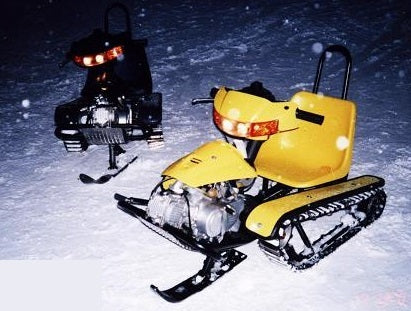
With the core dynamics proven, development continued toward a more complete machine. The open frame gave way to proper bodywork. Fit and finish improved. Multiple configurations were developed and tested in parallel, each one pushing further toward something that could be manufactured, delivered, and supported at scale.


The intermediate generation with full bodywork (left), and a field action shot from the same period (right). The machine had become genuinely capable in real snow conditions.


Production-intent variants developed in 1999 to 2000, alongside a 3D render of the mature platform configuration. Multiple units were built simultaneously during this period.


Workshop assembly during the production push. The level of engineering documentation produced during this period reflected serious commercial intent.
Why Commercialization Stalled
The technical concept had become convincing. The machine worked. Six units had been produced. But the commercial environment could not support what came next.
There was no stable financial backing to support tooling, supply chain, or sustained production at any meaningful scale. The project outgrew what self-funding could carry.
Custom components fabricated by hand could not be sourced commercially. Every part that needed volume pricing did not exist at volume. There was no route to cost-competitive production.
The concept was ahead of the market. Buyers did not have a reference point for a lightweight snow vehicle. The education cost of selling something new was higher than the infrastructure could support.
Even with a working product and early demand signals, there was no credible path to the production volume needed to make the economics viable. The project paused. Not because the engineering failed.
What Carried Forward
The first SnowKart chapter ended in 2000 without a commercial outcome. But it removed the most important uncertainty any new vehicle concept faces: it proved the fundamental dynamics worked.
Snow traction behavior, track loading, lightweight chassis balance, rider-control dynamics, and the specific geometry that made a compact snow vehicle controllable. All of that was now known. It had not been guessed or modeled in isolation. It had been ridden, tested, broken, and rebuilt until it worked.
The same lessons from these early machines reappear directly in ENVO's current SnowKart platform. The geometry, the track logic, the rider ergonomics, the weight balance. The electric version did not start from scratch. It started from 1997.
Hand-fabricated chassis, gasoline engine, twin-ski front configuration. Unstable, unreliable, and difficult at altitude. Proves the concept is worth pursuing.
Configuration shifts to single front ski and dual rear track. Stability and control improve significantly. Frame geometry, center of gravity, and track interaction become the primary engineering focus.
Dynamics reach a genuinely enjoyable level. Controllable handling, usable traction, real fun factor. Six units produced. Mostafa Mehrgerdi and Alireza Assef contribute to development and testing.
Full bodywork added. Multiple configurations tested in parallel. Engineering documentation produced at a level reflecting serious commercial intent. Commercialization attempted but not sustained.
Without funding, supply chain, or a route to scale, sustained production is not viable. The project pauses. The engineering is proven. The commercial infrastructure does not exist yet.
The Concept Still Rides.
ENVO's current electric SnowKart carries 25 years of snow dynamics knowledge. Same core engineering. No combustion engine.
Explore ENVO SnowKart
Share:
Electric SnowKart Gen 2 — ENVO Drive Systems
Electric SnowKart Gen 2 — ENVO Drive Systems