

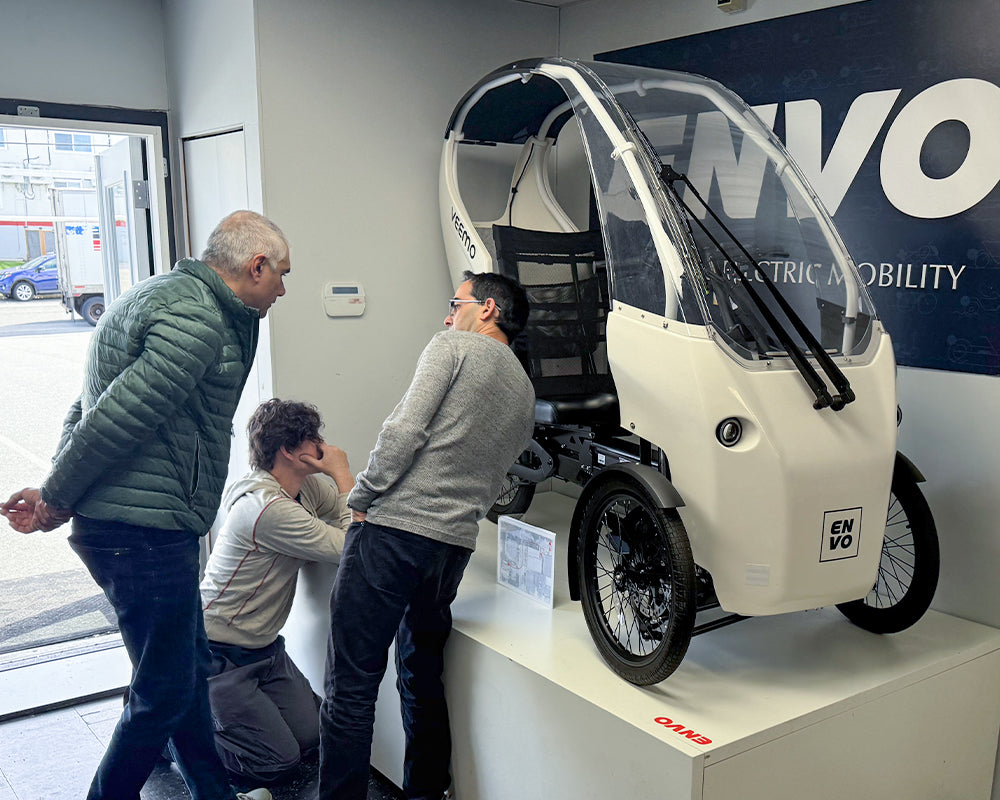
Last week, ENVO lent a Veemo electric trike to a collaboration that moved from concept to public presentation in under seven days. The result was a Veemo running the Magic Drive, a geared electromagnetic CVT developed by Israeli startup Charge Bike, demonstrated live at the Spezi specialty bike show in Germany.
This is not a product announcement. It is an early technical exploration. The Magic Drive on Veemo is unproven at this stage and will require significant field testing before any conclusions can be drawn. What this week demonstrated is that the technology is physically compatible and the concept is worth pursuing seriously.

What Is the Magic Drive?
The Magic Drive is an electromagnetic continuously variable transmission developed by Charge Bike, an Israeli startup. Unlike a conventional e-bike hub motor, the Magic Drive uses electromagnetic principles to vary the gear ratio continuously, eliminating the need for a mechanical derailleur, cassette, or external shifter entirely. The system combines the motor and transmission into a single rear hub unit.
For Veemo specifically, this integration has implications beyond convenience. Removing the mechanical drivetrain opens up three features that are directly relevant to how Veemo riders use the vehicle in urban conditions: true CVT pedaling feel with no shift events, brake-by-pedal, and reverse-by-pedal. None of these are achievable with a conventional chain-and-cassette drivetrain.
Continuous ratio adjustment with no discrete shift steps. Cadence remains consistent regardless of terrain, with no interruption to power delivery at transition points.
Reverse pedal input applies regenerative or mechanical braking. For a fully enclosed velomobile where hand placement and visibility are different from a conventional bike, this is a meaningful ergonomic gain.
Slow-speed reverse without dismounting. Relevant for parking a fully enclosed trike in tight urban spaces, a practical issue Veemo owners encounter regularly.
No derailleur, no cassette, no external shifter cable routing through the frame. Fewer components means fewer service points and reduced assembly complexity for production.
How the Week Unfolded
The project involved four organizations: ENVO (providing the Veemo platform and engineering support), Grin Technologies, Charge Bike (Magic Drive developer), and GEObike (ENVO's European assembly partner in Poland). The constraint was fixed: the Spezi show date did not move.
The Veemo rear fork and hub dropout geometry were reviewed against the Magic Drive axle specification. Interface requirements identified, custom parts scoped.
Justin and Alon manufactured the necessary interface components overnight to meet the integration timeline. Without this, the installation could not have proceeded on schedule.
Magic Drive installed into the ENVO Veemo in Canada. Initial functional verification completed. Basic CVT behavior and pedal input response confirmed. The drivetrain components were then removed from the Veemo and packed to travel with the team as carry-on luggage to Germany.
The Magic Drive components travel with the team to Germany. Simultaneously, GEObike — ENVO's European assembly partner in Poland — ships a Veemo directly to the Spezi venue so the team has a vehicle ready to receive the drivetrain on arrival.
The Magic Drive is installed onto the GEObike-supplied Veemo on site before the show opens. Grin, Charge Bike, GEObike, and ENVO present the completed build at Spezi — first public demonstration of the technology in a velomobile application.

What This Does Not Mean
The Magic Drive has not been validated for Veemo production. This demonstration involved one unit built in one week. Real validation requires hundreds of hours of field testing across urban conditions, load variation, temperature range, and long-term drivetrain durability. That work has not been done yet. ENVO will not adopt a new drivetrain for Veemo without completing that process.
The current Veemo production drivetrain uses a Shimano Altus chain-and-cassette system chosen specifically for universal serviceability: any bicycle shop in Canada, the US, or Europe can service it with standard tools. Any replacement system would have to meet or exceed that standard to be considered for production. That is a high bar, and the Magic Drive has not yet been evaluated against it in any systematic way.
Why It Is Worth Exploring
The features that the Magic Drive enables, specifically brake-by-pedal, reverse-by-pedal, and seamless CVT feel, are not achievable through incremental improvements to a mechanical drivetrain. If the system proves reliable under extended real-world testing, it would represent a meaningful functional upgrade for Veemo as an urban commuter vehicle.
The velomobile use case places specific demands on a drivetrain that differ from a conventional bicycle: a fully enclosed rider with limited external visibility, a heavier vehicle that parks in tight spaces, and daily urban use where low-speed maneuverability matters. The Magic Drive addresses exactly those demands. That alignment is what makes the exploration worthwhile.
What made this week possible was not just technology flexibility, it was organizational flexibility. Four companies with different geographies, product histories, and technical domains aligned on a shared timeline and a single deliverable. Justin and Alon fabricating parts overnight to keep the schedule is not a small thing. That kind of responsiveness is what separates teams that can test ideas quickly from those that can only plan them.

ENVO will continue monitoring the Magic Drive development and follow up with structured field testing if the technology matures to a point where production validation becomes appropriate. For now, the Spezi demonstration was exactly what it was intended to be: a first look at a promising direction, presented honestly, with the testing work still ahead of it.
Explore the Veemo
The Veemo velomobile is available now for delivery in North America and Europe, designed and supported by ENVO Drive Systems in Canada.
Explore Veemo
Partager:
Rad Power Bikes est en faillite : que s'est-il passé ? Qu'est-ce qui a causé la faillite ?
Meet the ENVO Stax DropBar: A Sub-$3,000 Drop-Bar E-Bike Built for Canadian Riders