

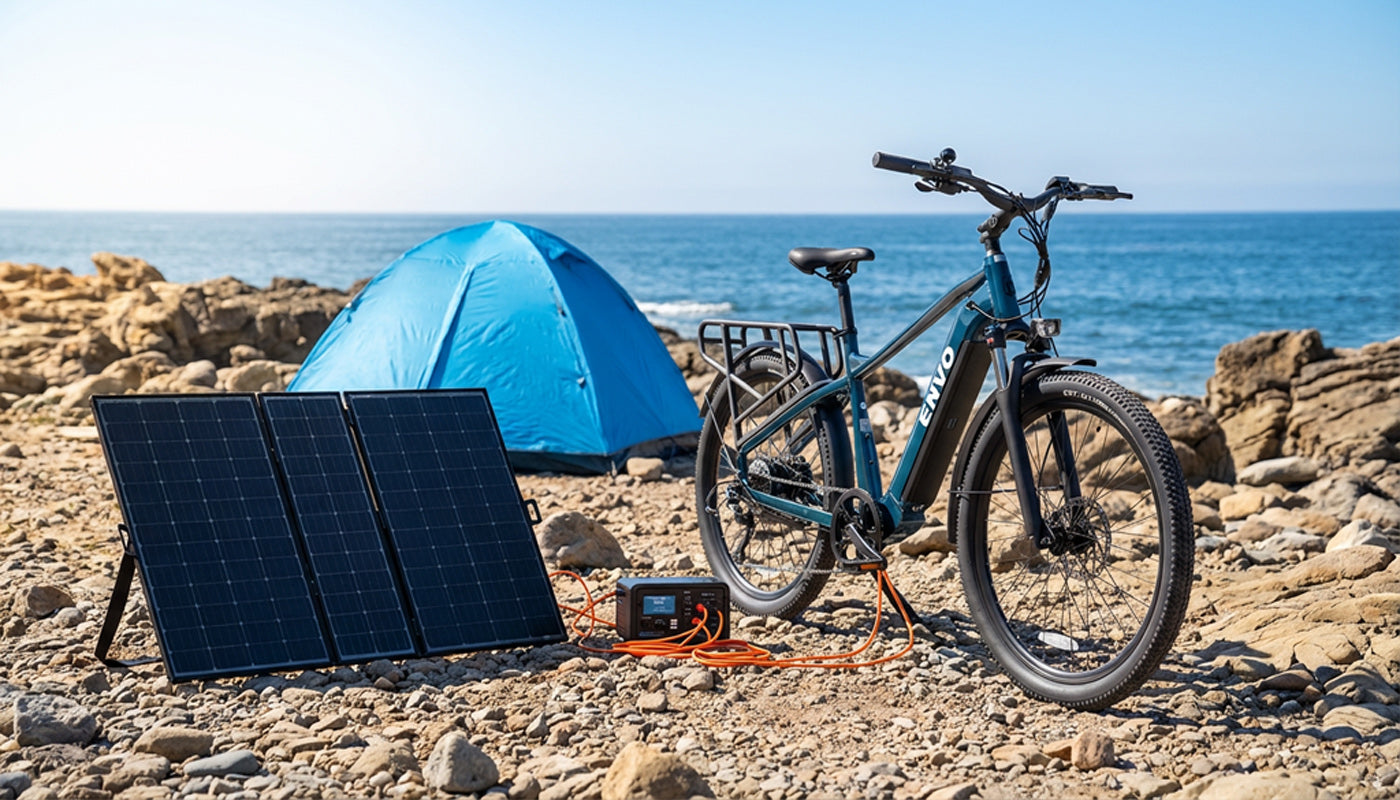
En théorie, la recharge solaire pour les vélos électriques semble simple : ajouter un panneau solaire, le brancher à une batterie et rouler grâce au soleil.
En réalité, recharger un vélo électrique à l'énergie solaire nécessite une conception de système minutieuse. Les besoins en énergie, la chimie de la batterie, la compatibilité de tension et, plus important encore, la communication chargeur-batterie et les protocoles de sécurité sont tous importants. Sans la bonne configuration, la recharge solaire peut être lente, inefficace ou dangereuse.
Ce guide explique comment fonctionne réellement la recharge solaire pour les vélos électriques, ce qu'il faut rechercher avant d'acheter une solution solaire, et la seule manière sûre et recommandée de recharger les batteries lithium-ion modernes de vélos électriques à l'aide de l'énergie solaire.
Peut-on réellement recharger un vélo électrique à l'énergie solaire ?
Oui, mais avec des limites claires.
La plupart des batteries de vélos électriques stockent entre 400Wh et 750Wh d'énergie, tandis que les panneaux solaires portables produisent une puissance relativement modeste. En pratique, la recharge solaire fonctionne mieux comme solution de recharge d'appoint ou échelonnée, et non comme un remplacement rapide de la recharge sur secteur.
Une installation solaire bien conçue peut :
-
Prolonger l'autonomie sur plusieurs jours
-
Recharger partiellement pendant de longs arrêts
-
Permettre une utilisation hors réseau ou à distance
-
Réduire la dépendance à la recharge murale
Ce que la recharge solaire ne peut généralement pas faire, c'est recharger rapidement une grande batterie de vélo électrique à partir de zéro en une seule session.
La seule manière sûre de recharger un vélo électrique à l'énergie solaire
🔒 Utiliser uniquement le courant alternatif et le chargeur approuvé par le fabricant
C'est non-négociable.
Les chargeurs de batteries de vélos électriques modernes sont conçus pour fonctionner avec une alimentation CA de 110V ou 220V, exactement comme une prise murale domestique. Par conséquent, la seule façon sûre et recommandée de recharger un vélo électrique à l'énergie solaire est la suivante :
Panneau solaire → générateur solaire régulé ou station d'alimentation (sortie CA 110/220 V) → chargeur de vélo électrique d'origine → batterie
La recharge directe en courant continu, l'utilisation de chargeurs CC génériques ou le contournement du chargeur d'origine présentent de graves risques pour la sécurité et ne doivent pas être utilisés.
Pourquoi le chargeur de vélo électrique d'origine est obligatoire

Les batteries lithium-ion de vélos électriques nécessitent un comportement de charge étroitement contrôlé. Les chargeurs approuvés par le fabricant sont adaptés pour :
-
Tension de charge exacte et limites de coupure
-
Profil de montée en courant et d'atténuation
-
Logique du système de gestion de batterie (BMS)
-
Protection contre la température, les pannes et l'équilibre des cellules
L'utilisation d'un chargeur tiers ou générique, même si la tension et le courant semblent corrects, peut :
-
Solliciter ou déséquilibrer les cellules individuelles
-
Contourner les hypothèses de sécurité du BMS
-
Provoquer une surchauffe ou des dommages internes
-
Augmenter le risque d'incendie
-
Annuler les garanties de la batterie et du vélo
Si une installation solaire ne peut pas alimenter en toute sécurité le chargeur d'origine, elle n'est pas compatible avec la batterie du vélo électrique.
Vélos électriques ENVO et autres vélos électriques conformes aux normes européennes modernes : architecture de charge CAN-Bus
De nombreux vélos électriques modernes qui respectent les normes européennes actuelles de sécurité et de système, y compris les vélos électriques ENVO de la série 50, utilisent des architectures de batterie et de chargeur basées sur le bus CAN.
Ce que cela signifie en pratique
Les chargeurs et batteries ENVO ne fonctionnent pas comme de simples systèmes d'entrée de tension / sortie de courant.
Au lieu de cela :
-
Le contrôleur de chargeur et le BMS de la batterie communiquent en permanence
-
La charge est ajustée dynamiquement en fonction de :
-
L'équilibre des cellules individuelles
-
La température de la batterie
-
La tension du bloc
-
Le courant de charge
-
Les états de défaut et de sécurité
Cette communication utilise des protocoles propriétaires.
Aucun chargeur tiers, convertisseur CC ou contrôleur solaire ne peut initier ou maintenir la charge en toute sécurité à moins qu'il ne corresponde entièrement au protocole de chargeur ENVO.
Implication critique pour la recharge solaire
À moins qu'ENVO (ou un fabricant similaire) ne conçoive et ne commercialise explicitement un chargeur propriétaire compatible solaire, il n'existe aucune autre méthode sûre pour recharger ces batteries via l'énergie solaire, si ce n'est :
Générateur solaire avec sortie CA 110/220V → chargeur standard spécifique ENVO → batterie ENVO
Toute tentative d'alimentation directe de la batterie en tension continue, quelle que soit la régulation, ne fonctionnera pas en toute sécurité et pourrait endommager la batterie ou désactiver le BMS.
Exigences en matière d'alimentation du chargeur (ce que les systèmes solaires doivent prendre en charge)
La plupart des chargeurs de vélos électriques standard fonctionnent à :
-
Systèmes 36 V, 48 V ou 52 V
-
Courant de charge de 2 à 4 A
Demande de puissance typique du chargeur :
-
36 V × 4 A ≈ 145 W
-
48 V × 3 A ≈ 145 W
-
52 V × 3 A ≈ 155 W
Règle de dimensionnement correct de l'alimentation
La source d'alimentation CA doit être évaluée à pas moins de 125 % de :
Tension de sortie × courant de sortie (en watts)
Exemple :
-
Chargeur 150W → minimum ~190W de sortie CA continue
Cette exigence limite les solutions solaires viables aux générateurs solaires ou aux stations d'alimentation qui :
-
Fournissent une sortie CA stable de 110/220V
-
Peuvent fournir en continu la puissance requise par le chargeur
Pourquoi cette méthode n'est pas la plus efficace, mais est la seule sûre
Oui, ce chemin de charge implique de multiples conversions :
-
CC solaire → CA (onduleur)
-
CA → CC de la batterie (chargeur)
Cela entraîne des pertes d'énergie à chaque étape. Cependant :
-
Il préserve le profil de charge conçu de la batterie
-
Il maintient toute la logique de sécurité du BMS et du bus CAN
-
Il élimine les hypothèses dangereuses de tension ou de courant
C'est la méthode de charge la plus pratique et la seule sûre pour les batteries lithium-ion modernes de vélos électriques.
Les pertes d'efficacité sont un compromis raisonnable pour la sécurité, la longévité et la protection de la garantie.
Puissance de sortie des panneaux solaires : attentes réalistes
Les panneaux solaires portables varient généralement de :
-
50-100 W (compact, pliable)
-
100-200 W (plus grand ou stationnaire)
Dans de bonnes conditions, un panneau de 100 W peut produire 300 à 500 Wh par jour, ce qui est suffisant pour :
-
Une recharge partielle
-
Une extension significative de l'autonomie au fil du temps
La recharge solaire récompense la patience et la planification, pas la rapidité.
Erreurs courantes à éviter
-
Recharger les batteries de vélos électriques directement à partir de panneaux solaires
-
Utiliser des chargeurs non approuvés ou des chargeurs rapides CC
-
Ignorer les exigences de communication CAN-Bus ou BMS
-
Sous-dimensionner les générateurs solaires
-
S'attendre à des recharges rapides et complètes avec de petits panneaux
La plupart des incidents liés aux batteries lithium-ion surviennent lors d'une recharge incorrecte, et non pendant l'utilisation.
La recharge solaire en vaut-elle la peine pour les vélos électriques ?
La recharge solaire est pertinente si :
-
Vous parcourez de longues distances sur plusieurs jours
-
Vous passez du temps hors réseau ou en extérieur
-
Vous souhaitez une recharge de secours ou d'urgence
-
Vous privilégiez la durabilité à la vitesse
C'est moins pratique si :
-
Vous avez besoin de recharges complètes rapides au quotidien
-
Vous manquez d'exposition constante au soleil
-
Vous souhaitez une solution simple et légère
En conclusion
Pour les vélos électriques ENVO et autres vélos électriques modernes basés sur le CAN-bus :
-
Utilisez toujours le chargeur approuvé par le fabricant
-
Alimentez-le toujours avec une alimentation CA régulée de 110/220V
-
Si un système solaire ne peut pas le faire en toute sécurité, il ne doit pas être utilisé
Tant que les fabricants ne commercialisent pas de chargeurs solaires propriétaires, les générateurs solaires CA associés au chargeur d'origine restent la seule solution sûre.
Partager:
Vélo et trajets quotidiens par tous les temps : ce que cela implique vraiment de rouler toute l'année
Vélos électriques pour la police : pourquoi les forces de l'ordre choisissent l'ENVO D50