

The future of e-mobility will not be shaped only by better batteries, more powerful motors, or smarter software. It will also be shaped by a more fundamental question: can one vehicle platform serve many different mobility needs without becoming too expensive, too complex, or impossible to scale?
This is where modularity becomes essential.
Today's mobility market is becoming more fragmented. Cities, communities, businesses, campuses, resorts, municipalities, farms, delivery operators, and recreational users all need cleaner electric mobility, but they do not all need the same vehicle. Some need compact utility transport, some need cargo capacity, some need off-road capability, some need passenger movement, some need low-speed road use, some need private-land operation, and some need a vehicle that can change with the job.
Traditional vehicle production does not handle this variety well. Conventional manufacturing is built around high volumes of relatively fixed products. That works for SUVs, pickups, sedans, vans, and motorcycles, but it works far less well for emerging light electric vehicle categories, where each niche may be real but not large enough to justify a fully separate product-development program.
A well-designed modular EV platform can share core systems, chassis, battery, drivetrain, suspension interfaces, control architecture, wiring, software, service parts, and production processes, while still letting the final vehicle be configured for different jobs. The customer gets variety. The manufacturer preserves scale.

Why Modularity Is Essential Now
The next generation of e-mobility should not be limited to electrified versions of the same old vehicle categories. The market needs more purpose-designed vehicles: compact commercial platforms, light-duty utility vehicles, cargo movers, adaptive mobility solutions, recreational EVs, industrial transporters, municipal service vehicles, and small-footprint urban mobility products.
But purpose-designed vehicles are difficult to commercialize if each one requires its own dedicated frame, tooling, electronics, battery system, suspension, body structure, assembly process, service system, and compliance pathway. This is why many promising mobility concepts never become real products. The idea may be valid, but the business case collapses before production.
Modularity changes that equation. Instead of building a completely different product for every niche, a company can develop a strong base platform and then create multiple configurations around it. Demand can be aggregated across several use cases instead of depending on one narrow segment, which makes niche mobility economically realistic. A modular platform can support different bodies, accessories, wheels, suspension setups, cargo modules, seats, protection systems, software settings, and application packages while still using common engineering DNA.
Efficiency Is a Community Priority
Electrification matters, but e-mobility also has to become more efficient in how vehicles are designed, sized, produced, transported, used, and serviced. Road transport is a major part of the global emissions challenge. The International Energy Agency identifies EVs as a key technology for decarbonizing road transport, a sector responsible for more than 15% of global energy-related emissions.
The answer cannot be only replacing every conventional vehicle with a similarly large electric one. Many daily trips and work tasks can be served by smaller, lighter, lower-energy vehicles. Communities face congestion, parking pressure, delivery challenges, emissions targets, and rising transportation costs. Businesses want more efficient tools, municipalities need clean and practical vehicles for local operations, and users want alternatives that sit between bikes and cars. Modular platforms help bring these solutions to market because they let multiple efficient vehicle categories share one development and production foundation.
So Why Don't We See Proven Modular EVs?
If modularity is so logical, why has the market not already produced several successful modular EV platforms? The answer is that the pain points differ for large manufacturers and startups.
Large manufacturers already have their markets. Their business is built around conventional vehicle categories, and their main battle is market share: one SUV against another, one pickup against another, one van against another. Their innovation is usually constrained by existing production systems, dealer channels, brand expectations, regulatory programs, and capital allocation. They may use modularity internally, but they are rarely trying to build a truly customizable mobility platform for emerging niche applications.
Startups see the opportunity more clearly, but they often fail for a different set of reasons. Many overestimated early-stage market readiness. Some attracted attention with bold renderings, long configuration lists, or large reservation numbers, but underestimated the cost of engineering, validation, tooling, supply chain, quality control, compliance, warranty, and service. Some over-engineered before proving demand. Others promised too many variants before proving one manufacturable product. The result is usually the same: delayed delivery, rising costs, frustrated customers, impatient investors, and a shrinking runway.
Another common mistake is the wrong use of early adopters. Early adopters are valuable, but they are not always a perfect representation of the larger market. Some startups misread early enthusiasm as proof of mass demand. Others used early adopters mainly as deposit holders and lost trust through delays, changing specifications, or poor communication.
There is also a strategic problem. Some startups copied software-startup behavior: announce, raise, collect attention, iterate later. But vehicles are physical products. They need safety validation, parts availability, repair systems, logistics, production documentation, and real-world durability. Other startups copied traditional automotive behavior: raise huge capital, build large facilities, and chase full-scale automotive manufacturing before proving a practical commercial path. Both patterns have failed many times.
Even successful companies often move back toward conventional vehicle production because near-term revenue is easier to understand there. Rivian is a good example. It built attention around a skateboard-style EV architecture, but its commercial lineup today is still organized around familiar categories such as electric pickups, SUVs, and delivery vans. That may be a rational business path, but it does not fully answer the need for truly customizable modular mobility platforms.
Ten Benchmarks and What They Teach
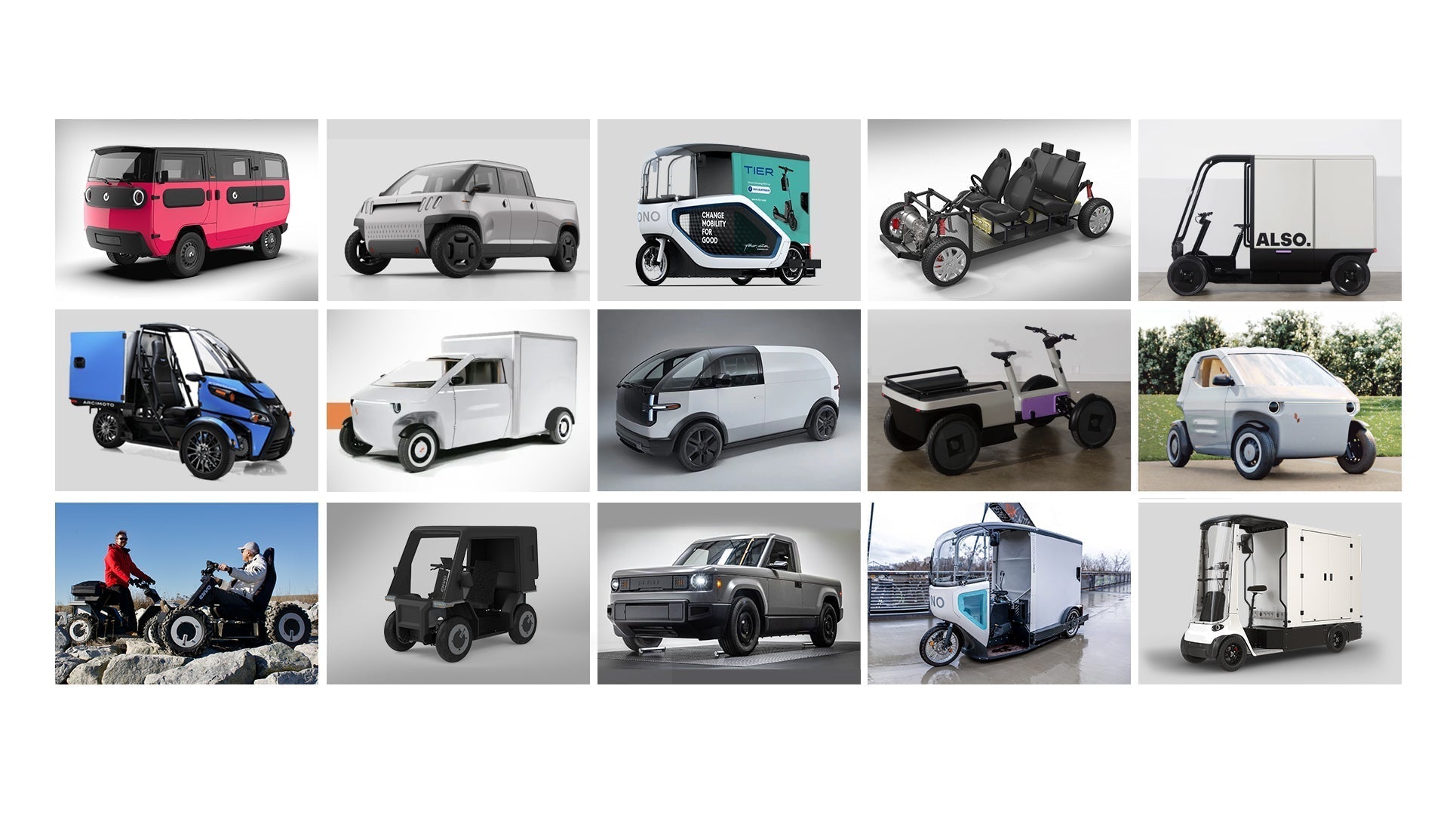
The mobility sector has seen several serious attempts at modular or configurable EV platforms. None has fully proven the full vision yet, but each one offers a useful lesson.
One small electric platform promoted with multiple bodies: van, pickup, camper, bus, off-road, utility. ElectricBrands filed for insolvency in 2024. The lesson: too many variants before production maturity can destroy focus.
A compact three-wheel platform expanded into the FUV, Deliverator, Rapid Responder, and Modular Utility Vehicle. It showed one platform can serve many missions, and how hard it is to scale production and reduce unit cost.
Connected to the Rivian ecosystem, approaching modularity through micromobility. Its TM-B e-bike is described as modular and repairable, with four-wheel cargo concepts and reported Amazon delivery interest.
A flat-pack concept using modular body structures shipped efficiently and assembled near the market. The lesson: modularity can cut cost not only in the product, but across the whole supply chain.
Built around the ONO e-cargobike for urban logistics. The company entered insolvency in 2024 and was transferred to Emoving GmbH. Even a real use case faces hard fleet economics and operating capital.
Modularity applied to urban logistics rather than lifestyle, with a Utility Cube concept for last-mile delivery. Strongest when tied to clear operational value: lower congestion, easier access, lower cost.
Its REEcorner architecture puts steering, braking, suspension, and drive into modular vehicle corners built around x-by-wire control. One of the clearest examples of deep platform modularity, aimed at commercial vehicles.
One of the most recognizable skateboard-platform visions, aimed at lifestyle, commercial, delivery, and pickup uses. Canoo filed Chapter 7 in January 2025. Strong design cannot overcome weak financial endurance.
A simple electric pickup designed for post-delivery customization, even into an SUV. Slate raised $650 million in 2026 with production targeted for later in the year. Modularity gains traction when it is simple and visible to the customer.
A completely modular, ready-to-use, open-source EV platform built to cut development cost and time. Openness alone is not enough; commercialization needs market access, production partners, compliance, and real customers.
What the Market Has Learned
The lesson from these benchmarks is not that modularity is wrong. The lesson is that modularity must be disciplined. The companies that struggled usually shared one or more of these problems:
Misled by crowd excitement, they over-engineered during product development and ran out of the budget needed for compliance and commercialization. The cost of physical product development underestimated. Prototypes confused with production readiness. Too much reliance on investor patience. Early adopter demand misread. Automotive-level cost structures carried into niche markets, with no staged commercialization plan and no trust built through delivery, support, and service.
The next successful modular EV company will likely do the opposite. It will start with a strong base platform. It will choose the first use cases carefully. It will commercialize a limited number of configurations before expanding. It will use common parts aggressively. It will design for assembly, service, and warranty from the beginning. It will treat early users as development partners, not just reservation holders. It will use modularity to simplify the business, not to create uncontrolled complexity.
Why the Opportunity Is Still Open
Despite all the attempts, the market still lacks a truly proven modular electric mobility platform for the large space between bikes and cars. There are e-bikes, cargo bikes, golf carts, ATVs, microcars, and full-size EVs. But there is still no widely adopted platform that can cost-effectively serve many compact road and non-road applications through true modular customization.
The need remains. Communities need cleaner and more efficient mobility tools. Businesses need lower-cost electric utility vehicles. Campuses and resorts need compact people movers. Municipalities need small service vehicles. Delivery operators need alternatives to vans. Recreational users want transportable electric platforms. Many users need something more capable than a bike but far less costly and bulky than a car.
Investment appetite in e-mobility is not what it was during the hype cycle. That makes it harder for speculative startups to raise large capital around unproven concepts. But it may create an advantage for self-sustained companies that already understand product development, production, logistics, service, and niche customer needs.
Why ENVO's UPT Project Matters
This is the opportunity ENVO is pursuing with the UPT project. UPT, the Utility Personal Transporter, is being developed as a compact four-wheel modular platform designed to fill the mobility gap between bikes and cars across many road and non-road applications.
The purpose is not to create one more small EV. The purpose is a scalable platform that can support multiple configurations while preserving a common engineering and production foundation. UPT is intended to support a wide range of practical applications: utility, recreation, compact transport, commercial use, municipal service, off-road mobility, adaptive applications, and other light-duty tasks where conventional vehicles are too large, too expensive, or too inefficient.
Customization without losing scalability. A customer may need a different body, tire setup, suspension package, accessory set, cargo structure, seat layout, or operating configuration. But underneath, the platform retains shared systems, shared service logic, shared components, and shared production discipline. That is how modularity moves from concept to commercialization.
The Future Is Modular, If Built Properly
The future of e-mobility should be modular because the market needs more variety than traditional vehicle production can economically provide. The world does not need only more electric cars. It needs more purpose-designed electric mobility solutions: compact platforms, utility platforms, cargo platforms, recreational platforms, and commercial platforms that can be produced cost-effectively without each becoming a separate industrial project.
But modularity is not magic. It does not excuse poor planning, weak execution, delayed delivery, or unrealistic promises. The companies that succeed will be the ones that use modularity with discipline: common architecture, limited early configurations, clear use cases, scalable manufacturing, strong service support, and honest commercialization.
The mobility sector continues to starve for real modular, customizable electric platforms. Many have tried. Few have delivered. That leaves the opportunity open. With UPT, ENVO aims to be one of the first companies to bring a practical, commercially grounded modular four-wheel electric platform to market, not as a futuristic concept, but as a real product system designed for scalable customization and everyday utility.
Built in Canada. Built to Scale.
ENVO designs and supports its electric mobility platforms in Canada, with an engineering-first approach and real service behind every product.
Partager:
Vélos électriques pour la police : pourquoi les forces de l'ordre choisissent l'ENVO D50
Modular Mobility and Rightsized Mobility: Two Different Ideas Shaping the Future of E-Mobility