

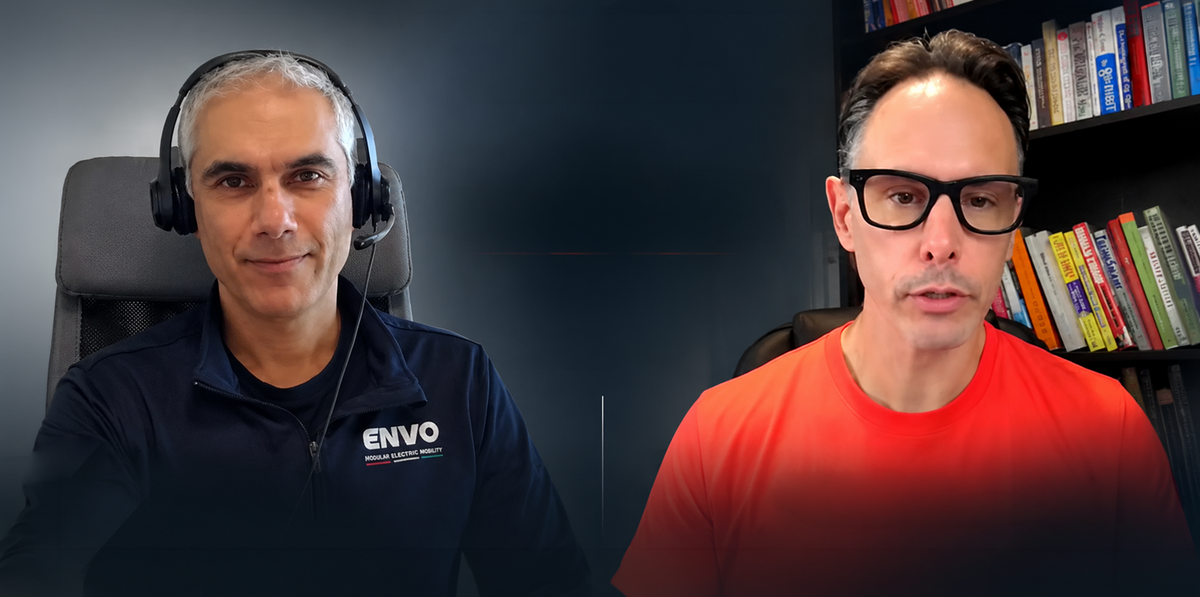
ENVO founder Ali Kazemkhani on building a company without outside capital, the pressure of time and seasons, and both sides of artificial intelligence.
On Episode 52 of The People-Driven CEO Podcast, released October 14, 2026, host Shane Jeremy James sat down with Ali Kazemkhani, founder and CEO of ENVO Drive Systems in Burnaby, BC.
Their conversation moves from an engineering childhood in Tehran to the realities of building a company without outside capital, the pressure of time and seasons, and both sides of artificial intelligence. It ends with the question Shane asks every guest: what does it mean to be human?
From Tehran to Right-Sized Mobility
Shane Jeremy James: Give us the Cliff Notes of your backstory, and a little of what you're doing today.
Ali: As a kid, I tried to make my bicycle run on a tape recorder motor. It didn't work, but I kept the passion, made and broke a lot of toys, and became a mechanical engineer, with a master's focused on automotive.
I was born and raised in the most polluted city in the world, and I carried that pain with me: congestion, and single-passenger cars moving two or three tons of metal from point A to point B. Those problems still exist, but now we have the technology and the community adoption to act.
Our mission at ENVO is right-sizing mobility for a healthier community.
Starting From What People Already Need
Shane: So do you build the technology, the e-bikes, or both?
Ali: We are an engineering company, and we start from what the market needs. Instead of telling everyone to ditch their cars, we find people who already want an alternative but don't have a practical or affordable one, and we deliver it to them.
After ten years, we're starting to offer products people don't know they need, like an electric snow bike you can pedal. We manage that variety through modularity: three types of battery power 30 different products. It's variety without complexity.
A Different Definition of Business
Shane: That's not an easy type of company to start. Tell us about some of the challenges.
Ali: When I moved to Canada, I already had a life of serial entrepreneurship behind me, including an e-bike manufacturing business I started in Iran in 2001. I also brought the mentality of a Middle Eastern startup. In many parts of the world, your family gives you money to start a business. If you don't have it, you don't start. There's no angel investor, no VC.
In North America, I learned that you can raise money around an idea and eventually sell the business itself.
Family money starts the business. No angel investors, no VCs. If you don't have the money, you don't start.
Raise money around an idea, grow it, and eventually the business itself becomes something you can sell.
I didn't know that approach, so I started ENVO the old way, which here is called bootstrapping. I developed two conversion kits, sold them online, and had enough money to make ten. Ten gave me enough to make thirty. After two years, we could hire employee number one.
We're still in bootstrap mode. We're open to investment for growth, but we live on operational cash flow. The first product made the second, and the second made the third and fourth. After COVID, I saw many e-mobility brands close.
If you don't earn it, you don't spend it, so you don't create debt.
Time Is the Enemy
Shane: You need people who are willing to wear six hats.
Ali: Exactly. But the biggest challenge is time. You need time to do things right, but the clock is ticking: payroll, the lease, and there are always delays.
Then there's seasonality. There's roughly a one-to-seven ratio between our low and high seasons. With a product like the snow bike, you have about three months a year to sell. Miss one month and a third of that business is gone. And without deep pockets, you can't invest six months ahead.
Shane: When you raise all that money, the dynamic changes. Now you have a board to report to.
Ali: I don't want big money. I need enough resources to hire five more people to do five more important things. We work with our own money, so our lives depend on it. There's no exit for people like me.
AI: Purpose Still Belongs to People
Shane: How are you using AI, and what are your thoughts on it?
Ali: Over the past two years, we've been ramping up AI across all our operations. It's not here to replace anyone. It's about doing more with our existing team. It's very exciting.
"I have purpose. AI does everything other than purpose."
A complex task might take six minutes, and the result can equal at least two weeks of a director's work, for a few cents.
But there's always a dark side. A younger engineer joining our team has, I would say, lost half the capabilities my generation had, because of exposure to AI and research tools. Engineers have come to rely on the machine's power instead of brain power, and that's going in a scary direction.
Not replacing anyone, but doing more with the existing team. Six minutes of AI work can equal at least two weeks of a director's work.
Relying on the machine's power instead of brain power, and what that means for independent thinking in the next generation.
Shane: Many leaders aren't training their people to think critically about what AI gives them.
Ali: What concerns me most is how deeply our brains will be trained to be lazy. If you don't use your gray cells, they won't grow. I'm not worried about my business. We can flourish with AI for the next five or ten years. I'm worried about my kid and that generation.
- Can they communicate?
- Can they think critically?
- How much control will they give AI-managed media over their lives?
I can't see yet what will correct this. But let's be hopeful, and let's be part of the solution.
What Being Human Means
Shane: What does it mean to be human?
Ali: What being human means to me is to be different from other creatures, like animals who eat, leave things behind and then get eaten by another animal. Let me try to use my own words; English is my second language.
I want to be human in the sense that the world feels a difference with or without me, that it experiences an impact from my existence in a meaningful way. That's what I try to do in my work and my life, as a parent, a husband and a friend.
"I want the world to be better with me than without me."
Shane: When I started asking this question, I thought the answers would be similar. They've been so different.
Ali: You know what the fear is? In five or ten years, everyone might give the same answer, because they asked an AI trained on mainstream answers. I hope we keep hearing different opinions for decades.
This interview has been edited for clarity and length.
Partager:
UPT Production Progress: Manufacturing, Pilot Assembly and Testing Underway