

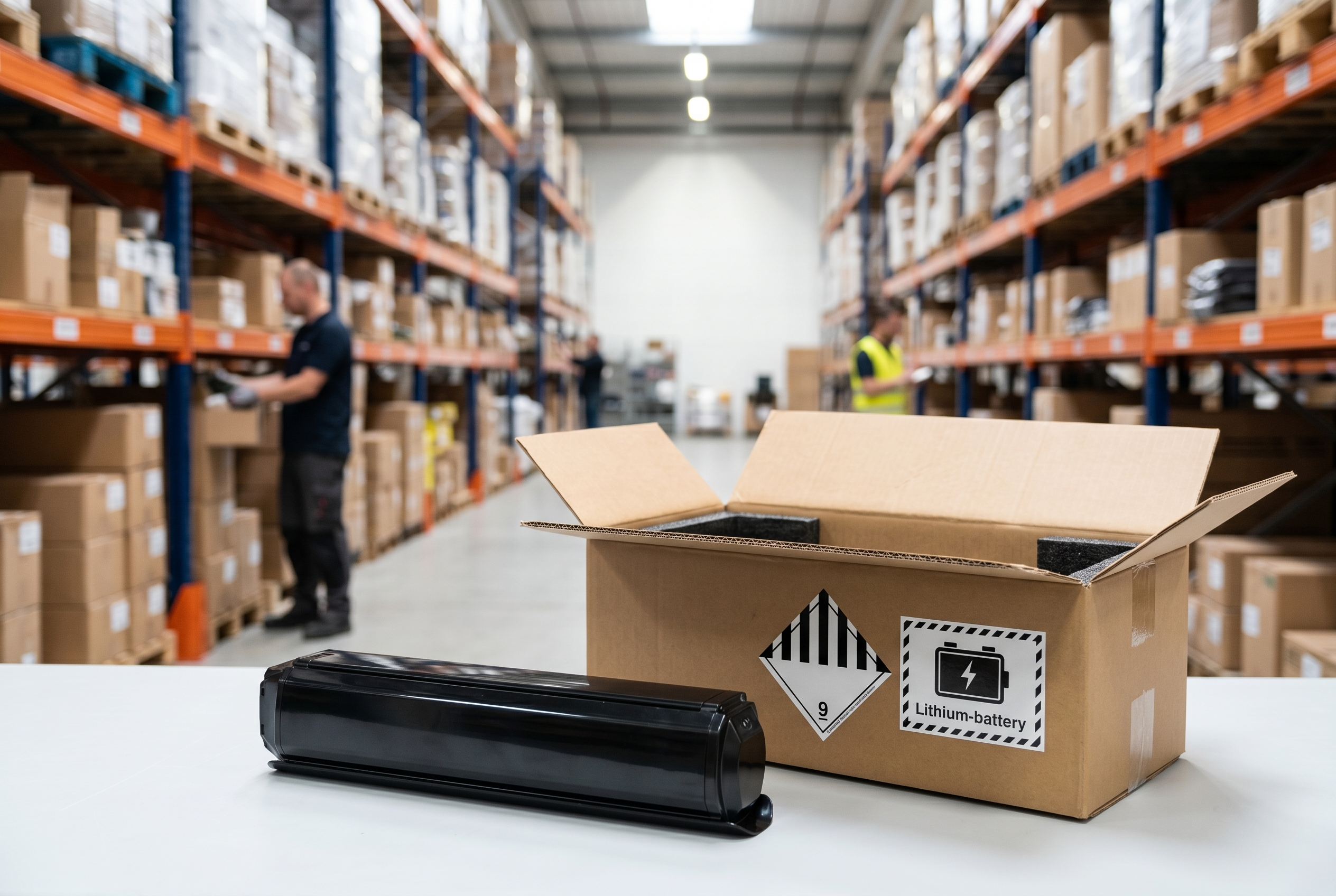
Most people who own an e-bike will never think about the regulatory status of their battery. They charge it, ride it, and forget about it. But the moment a new battery has to travel separately from the bike — for a spare-battery purchase, a service exchange, or a dealer transfer — it enters a regulatory framework that is unfamiliar to most consumers and, frankly, to a large number of dealers.
Lithium-ion batteries are classified as Class 9 Dangerous Goods. That status does not change because the battery is being shipped by an individual rather than a manufacturer, and it does not change because the battery looks fine on the outside. It is a legal classification that triggers specific obligations around packaging, marking, documentation, personnel training, and carrier selection.
Ordinary parcel services are not authorized to move them under normal terms, and the penalties for non-compliance are not trivial. This article walks through what the rules actually say in Canada and the United States, where the responsibility sits at each step, and what a sensible shipping process looks like for an e-bike company, a dealer, and an end customer. It is not legal advice. It is a working explanation of the regulatory environment that every serious participant in the micro-mobility industry now has to operate within.
Why E-Bike Batteries Are Regulated Differently
A typical e-bike battery sits between 400 and 700 watt-hours. That is a meaningful amount of stored chemical energy in a single package. Lithium-ion cells, by their nature, can fail in ways that conventional consumer products cannot — through thermal runaway, internal short circuits, electrolyte decomposition, and propagation across adjacent cells. We have written about the physics of thermal runaway in a separate article. The transportation regulators have written about it too, which is why these batteries are treated as hazardous materials when they move through the supply chain.
In Canada, the framework is the Transportation of Dangerous Goods Act, 1992 and the TDG Regulations administered by Transport Canada. In the United States, it is the Hazardous Materials Regulations in 49 CFR Parts 171–180, administered by the Pipeline and Hazardous Materials Safety Administration (PHMSA). The two frameworks are closely aligned. Both classify lithium-ion batteries as Class 9, both require UN-specification packaging for standalone shipments, and both impose training and documentation requirements on any party who offers a battery for transport.
The critical word in the regulations is “offers.” The legal obligation falls on whoever prepares the package and hands it to a carrier. That party is the shipper, and the shipper is responsible for compliance regardless of whether they are a manufacturer, a dealer, or an individual consumer.
The Three Shipping Scenarios
There are three distinct configurations under which an e-bike battery can move, and they are not regulated equivalently.
When the battery is shipped inside the complete vehicle, the shipment is classified as a battery-powered vehicle. Both Canadian TDG Special Provision 96 and US 49 CFR 173.220(h)(1) exempt these shipments from most of the regulatory burden when transported by road or rail — including training requirements. This is the cleanest path, and the reason most e-bike companies prefer to ship complete bikes wherever possible.
When the battery ships in the same package as the equipment it powers but is not installed in it, this classification applies. It requires full Class 9 compliance, including UN-spec packaging, proper marking, and a dangerous goods shipping declaration.
This is the configuration most spare-battery sales, dealer transfers, and service exchanges fall into. It triggers the full set of regulatory requirements: UN-certified packaging, Class 9 lithium battery marking, hazmat shipping papers, trained personnel, and a carrier account authorized to accept dangerous goods.
Typical e-bike batteries sit well above the watt-hour thresholds that allow simplified shipping under the small-battery exceptions. A 500-watt-hour pack is treated as fully regulated Class 9, not as an excepted small battery. This matters because it closes off most of the simpler shipping options that work for laptop and power-tool batteries.
Where the Training Requirement Actually Lives
This is the part that consistently surprises people. Under both Canadian TDG Part 6 and US 49 CFR Subpart H, anyone who prepares a battery shipment, completes the documentation, or tenders the package to a carrier must be trained. In Canada, this means holding a valid TDG training certificate issued by an employer, with the underlying competency framework defined by Transport Canada. The ground-transport certificate is valid for 36 months. In the US, hazmat employee training under 49 CFR §172.704 must be renewed every three years.
The training is not theoretical. It covers classification, packaging selection, marking and labelling, shipping paper preparation, emergency response information, and incident reporting. There is no general exemption for occasional shippers. A bike shop that ships one battery a year is held to the same standard as a logistics company that ships one a day.
For dealers, this creates a clear operational requirement: at least one trained employee must be available whenever a battery shipment is being prepared. For end consumers, it creates a practical barrier — almost no individual consumer holds a valid TDG or 49 CFR certificate, and the major parcel carriers will not accept a battery shipment from an account that is not pre-approved as a dangerous goods shipper.
Carrier Reality in Canada
The three major parcel carriers operating in Canada — UPS, FedEx, and Purolator — all accept Class 9 lithium battery shipments, but only under contract accounts. None of them will accept a battery shipment dropped off at a retail counter under a standard parcel account.
- UPS Canada explicitly requires a compliant shipping system, formatted shipper declarations, and a pre-approved hazmat account. Contact with their dangerous goods support centre is the standard onboarding path.
- FedEx Express in Canada accepts lithium batteries through specific service options. FedEx Ground hazmat shipping is not available in Canada at all — a frequently misunderstood point.
- Purolator offers a contracted Dangerous Goods program with similar pre-approval requirements.
A consumer who walks into a parcel counter with an e-bike battery in a cardboard box is not going to be served. The shipment will either be refused or, worse, accepted by an employee who does not recognize it and then intercepted further down the network — which can lead to refused delivery, account flags, and in some cases reporting to Transport Canada.
The Compliant Customer Paths
For an e-bike company, this regulatory environment shapes the way new-battery shipments to and from customers actually have to work. The IATA-recognized framework is explicit: companies arranging movements of lithium batteries from consumers are responsible for developing clear consumer instructions that cover packaging materials, lithium battery marks, transport method, mode, and applicable prohibitions. The compliance burden cannot be transferred to the consumer by default; it has to be designed into the process.
For new battery movements, there are two workable customer-side paths.
Authorized Dealer Drop-Off or Pickup
The customer brings the battery to an authorized dealer in person, or picks up a new battery from one. The dealer inspects, packages, and tenders the shipment under their own trained-staff workflow when onward transport is required. A reasonable handling fee is appropriate, since the dealer is carrying real operational cost — UN-spec packaging, documentation time, and DG carrier fees. This is the most accessible compliant path for most consumer transactions.
Manufacturer-Arranged Dangerous Goods Transport
The e-bike company books the shipment directly with a contracted dangerous goods carrier, using their own trained shipping staff, UN-spec cartons, and shipping papers. The customer does not interact with the carrier counter at all. This is the standard path for spare-battery direct sales and for service exchanges arranged through the manufacturer.
Asking the customer to ship a battery themselves through a standard parcel service. It is not compliant, it is not safe, and it exposes both the customer and the manufacturer to regulatory risk.
What This Means for the Industry
The e-bike industry in North America is still maturing its supply chain. A decade ago, the volume of consumer-bound battery shipments was small enough that the regulatory framework operated mostly in the background. That is no longer the case. With millions of e-bikes now on the road, and with battery fires receiving significant regulatory and media attention, the enforcement posture from Transport Canada and PHMSA has tightened, and the carriers have responded by hardening their acceptance criteria.
Dealers who treat battery shipping as an occasional task rather than a structured competency will increasingly find themselves blocked at the carrier counter. E-bike companies that do not provide their dealer network and customers with a clear, compliant shipping path will increasingly find themselves carrying the regulatory exposure for failures further down the supply chain. The companies that handle this well — the ones that build trained shipping staff, contracted dangerous goods accounts, and validated UN-spec packaging into their operating model — are the ones that will be in a position to scale.
Practical Guidance for Owners
If you are buying a spare battery, arranging a service exchange, or otherwise need a new battery sent to or from your address, the simplest and safest path is to work directly with the brand or an authorized dealer. A reputable manufacturer will either book the shipment with a contracted dangerous goods carrier on your behalf, or direct you to a local authorized dealer who can handle the transaction in person. Either of these is far preferable to attempting to ship a lithium-ion battery yourself.
If a parcel carrier counter ever refuses a battery shipment, that is the system working as intended — not an inconvenience to be worked around. Compliant routing exists for a reason, and the manufacturer or dealer is the right party to coordinate it.
Closing Note
Regulation often gets criticized as friction, and sometimes that is fair. But the rules governing lithium battery transport exist because the failure modes of lithium-ion chemistry are genuinely real, and because a single uncontained thermal event in a parcel truck or a cargo aircraft can have consequences that go well beyond the battery itself. The framework is not perfect, and parts of it are still adapting to the realities of micro-mobility, but the underlying logic is sound.
The e-bike industry is at its best when it takes the harder, more disciplined path on safety. That means UL-certified batteries, well-designed BMS systems, traceable cell sourcing, and a shipping process that respects the regulatory framework rather than working around it. We have been building toward that posture at ENVO for years, and we will keep doing so. The micro-mobility transition is too important to get wrong on the boring parts.
Quick Reference Table
| Scenario | Classification | Compliance Path |
|---|---|---|
| Complete bike with battery installed, shipped by ground | UN 3171 | Mostly exempt; standard ground shipping with marking |
| Spare battery shipped alone | UN 3480 | Full Class 9 compliance; trained shipper required |
| Battery shipped in same package as bike (not installed) | UN 3481 | Full Class 9 compliance; trained shipper required |
| Customer spare-battery purchase or service exchange | UN 3480 | Manufacturer-arranged DG transport or authorized dealer pickup |
Sources and Further Reading
- Transport CanadaTransportation of Dangerous Goods Regulations, Part 6 (Training)
- PHMSA49 CFR Parts 171–180, with emphasis on 173.185 (Lithium cells and batteries)
- PHMSALithium Battery Guide for Shippers (2024 edition)
- UPS CanadaHazardous Materials Service Definition
- ENVOThermal Runaway in Lithium-Ion Batteries: Causes, Risks, and Prevention
Built on the Boring Parts
ENVO designs, certifies, and supports e-bikes built for the long haul — including a shipping process that respects the regulatory framework. Explore the lineup.
Explore ENVO E-Bikes
Share:
New Jersey’s E-Bike Law S4834: A Cautionary Tale of Safety and Overreach
CUSMA Review July 2026: Why Canadian E-Bike Buyers Could Pay $500–$1,500 More After the Joint Review
1 comment
Looks like any ebike dealer shall have a certified DG goods shipmnet personnel