

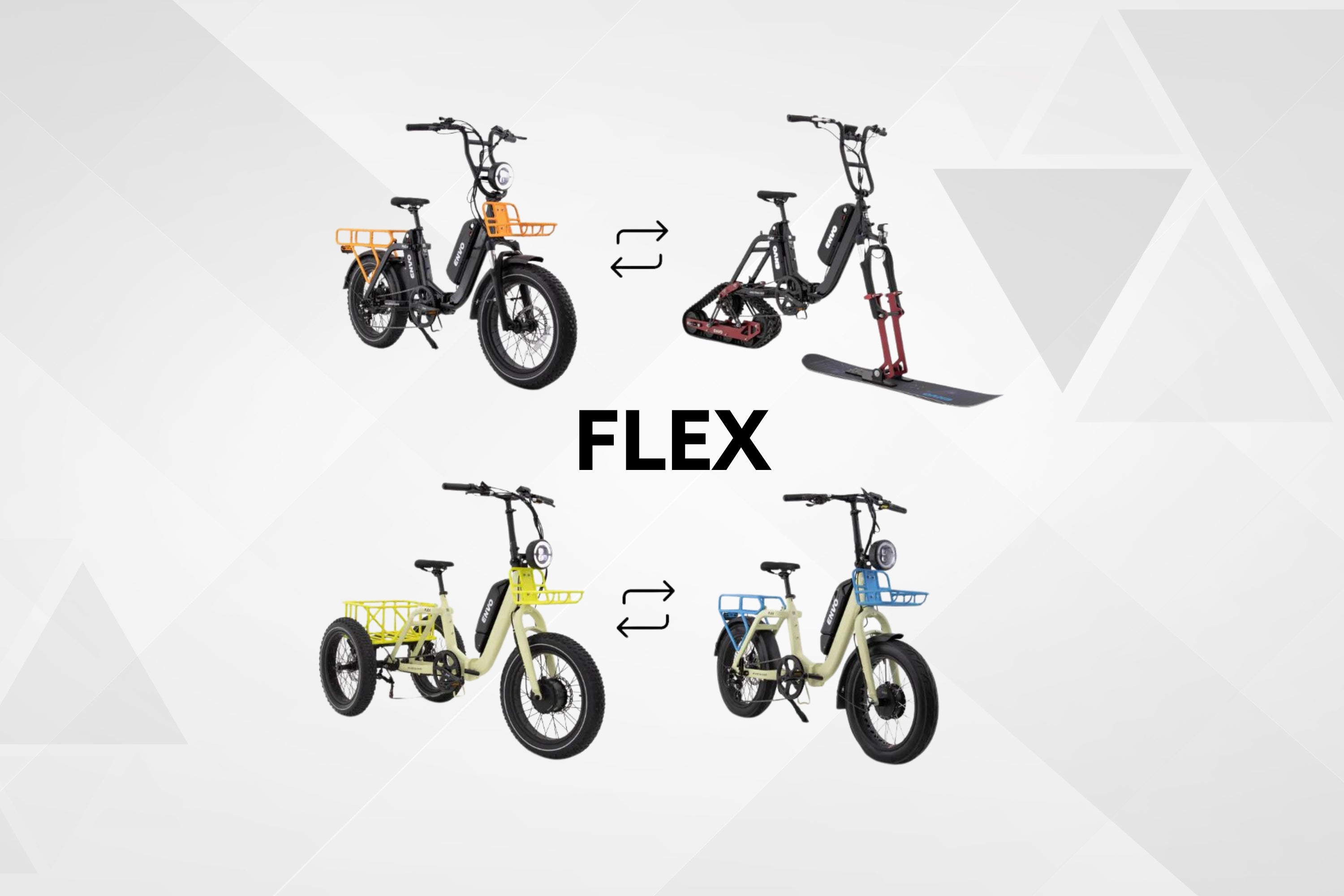

Most vehicle products are built for one thing. A cargo bike is a cargo bike. A snowbike is a snowbike. The engineering brief is clear, the geometry is fixed, and every decision compounds toward a single known purpose.
FLEX was the opposite. Starting in 2020, ENVO set out to build a single frame that could legitimately function as four different vehicle types: an off-road fat-tire utility bike, a compact cargo bike capable of carrying child seats, an adult electric trike, and a winter snowbike using a rear track and front ski. Not as marketing variations, but as real, mechanically distinct configurations built on the same chassis.
The FLEX platform is one of ENVO's most significant engineering projects, not because it produced a single successful product, but because it proved something harder: a shared frame architecture can absorb contradictory requirements without collapsing into compromise.
Where It Started
By 2020, ENVO had already established two well-defined product lines: the D35 urban commuter and the Lynx compact portable e-bike. Both addressed real segments effectively. But customer feedback kept pointing toward needs that neither product solved.
Some riders needed genuine off-road capability with cargo capacity. Others wanted a stable trike platform for utility or mobility use. A growing number asked about winter riding, beyond what a standard bicycle with winter tires could offer. And ENVO's existing DIY SnowBike conversion kit, while functional, still depended on a customer-supplied bicycle and was not a fully integrated product.
The engineering question that emerged internally was this: instead of building a separate product for each category, could one frame architecture serve all of them?
That question became FLEX.
The Engineering Problem
On paper, the four target configurations share some geometry. In practice, they each pull the frame design in opposing directions.
Fat tire clearance affects chainline and pedaling stance. Snow track clearance changes the entire rear drivetrain geometry. Trike conversion requires a fundamentally different rear axle structure. Cargo loading changes stiffness requirements throughout the frame. And folding, a key FLEX feature for storage and transport, introduces structural risk if not managed carefully through the fold joint and locking mechanism.
One issue that dominated early development was Q-factor: the lateral distance between pedals. Accommodating wide rear configurations like snow tracks or fat tires while keeping the pedaling stance ergonomically natural required many iterations. It sounds like a small detail. In practice, it dictated tube routing, bottom bracket placement, and rear chainstay geometry across every configuration.

ENVO FLEX frame drawing, July 2021. AL-6061-T6 aluminum, with detailed chainstay, dropout, and fold-joint dimensions.
The frame also had to integrate rear passenger interfaces, including mounting points for two child seats, while remaining compact enough to fold and be transported by a single person. These requirements do not naturally coexist. Getting them to coexist without making the frame heavy, ugly, or difficult to manufacture took sustained iterative work.
Development Under Constraint
The FLEX project ran through 2020 to 2022 under the technical leadership of Ali Kazemkhani, M. Haseeb Javed, and Laurent Belisle. The team was working during the global COVID period, which added layers of difficulty: supply chains were unstable, custom components were difficult to source, manufacturing lead times were unpredictable, and tooling conversations with suppliers were interrupted repeatedly.

Hand-annotated frame drawings from the FLEX development process, showing working notes and field measurements.
The frame design exceeded 15 major revisions before the team stopped formally counting them. Several components had to be custom-developed because standard bicycle parts did not exist for the exact packaging requirements, particularly around rear drivetrain layout, cassette spacing with wide tires, and the modular attachment interfaces for snow and trike configurations.
The work began as 2D frame architecture and evolved into full 3D CAD development as the design matured. Early prototypes revealed conflicts that drawings did not, and each round of physical testing produced new geometry constraints that fed back into the next revision.
Anyone who has seriously designed even one of these vehicle categories knows how difficult it already is. Combining four of them into one frame, without degrading any of them, is a genuinely unusual engineering problem. FLEX is the result of accepting that difficulty rather than designing around it.
The Four Configurations

Early CAD renders of the four primary FLEX configurations: trike, urban, cargo/overland, and snowbike with track and ski.
Fat-tire off-road utility bike for trails, sand, snow-packed paths, and rough terrain. The first configuration to reach commercial production, in 2021 to 2022.
Compact utility and passenger-carrying configuration with integrated rack mounts and child seat compatibility. Designed to fold for apartment and transit use.
Adult electric trike using the same base frame with a rear axle module swap. Stable, cargo-capable, and suitable for riders who need three-wheel stability for utility or mobility reasons.
Winter adaptation using a rear rubber track and front ski fork. Replaces wheels entirely. Chain-driven through the same drivetrain. Entered scaled Canadian production in 2022.
First Production Results


Left: FLEX 750W rear hub with dual rack configuration. Right: FLEX SnowBike in field conditions.
The first commercial expression of the FLEX platform was the FLEX Overland, a foldable fat-tire e-bike designed for off-road and utility use. It reached customers during 2021 and 2022 and represented the most balanced initial release, capturing the core advantages of the platform while remaining manufacturable at scale.
The FLEX Trike followed, adapting the same frame with a differential rear axle module for three-wheel stability and extended cargo capacity.
The SnowBike configuration was validated through prototype testing and entered Canadian production in 2022, confirming that the original design intent was achievable: one frame that could genuinely support winter use by replacing the wheel assemblies with track and ski modules.

ENVO FLEX SnowBike: rear rubber track, front ski fork, and the same FLEX frame and drivetrain shared across all configurations.
The Trike: Stability and Utility

ENVO FLEX Trike with front and rear cargo baskets. The same frame geometry and powertrain as the two-wheel configurations.
The trike configuration addressed a market that most e-bike brands have consistently underserved: adults who need three-wheel stability for balance, mobility limitations, or heavy utility loading. The FLEX Trike did not require a purpose-built frame. It required a rear module swap and the correct rear axle system, both of which the FLEX platform was designed to accept from the outset.

FLEX Trike folded. The fold mechanism was engineered as a primary requirement, not an afterthought, across all FLEX configurations.
How FLEX Evolved After First Generation
FLEX did not stop at its initial commercial generation. The platform continued developing through 2024, with refinements in battery integration (including UL-certified battery packs), higher-grade utility components, differential-based trike systems for smoother cornering, and improved manufacturing quality throughout.
Each generation drew on what the previous one taught, both about what the platform could tolerate and where additional engineering investment would pay back in durability and ride quality.
Why FLEX Matters
FLEX is significant in ENVO's history not because it was the company's best-selling product at any given moment, but because it proved a design thesis that most small manufacturers never attempt: platform-level thinking, where the engineering investment is made once in the shared architecture, and product variants are expressed from that common base.
That approach directly shaped what came after FLEX, including UPT (Universal Platform Technology), ENVO's advanced cargo systems, and later modular mobility projects. The methods developed during FLEX, from managing conflicting geometry requirements to integrating modular rear assemblies, became part of how ENVO approaches vehicle development.
FLEX established ENVO's first true modular frame platform, the first shared chassis for cargo, trike, off-road, and snow use, and the direct precursor to UPT and later modular mobility systems. It was the first proof that ENVO could design platforms, not just products.
See FLEX in Motion
The following video documents the FLEX SnowBike in real winter conditions, showing the track and ski configuration in use:
ENVO FLEX SnowBike: track and ski configuration in field testing
Built on a Platform. Not a Promise.
ENVO e-bikes are engineered, tested, and supported in Canada, with real-world durability and a team that stands behind every product.
Explore ENVO E-Bikes
Share:
Project Brief: ENVO Velomobile
1 comment
Je voudrait savoir comment collecté la deuxième batterie sur mon flex trike