

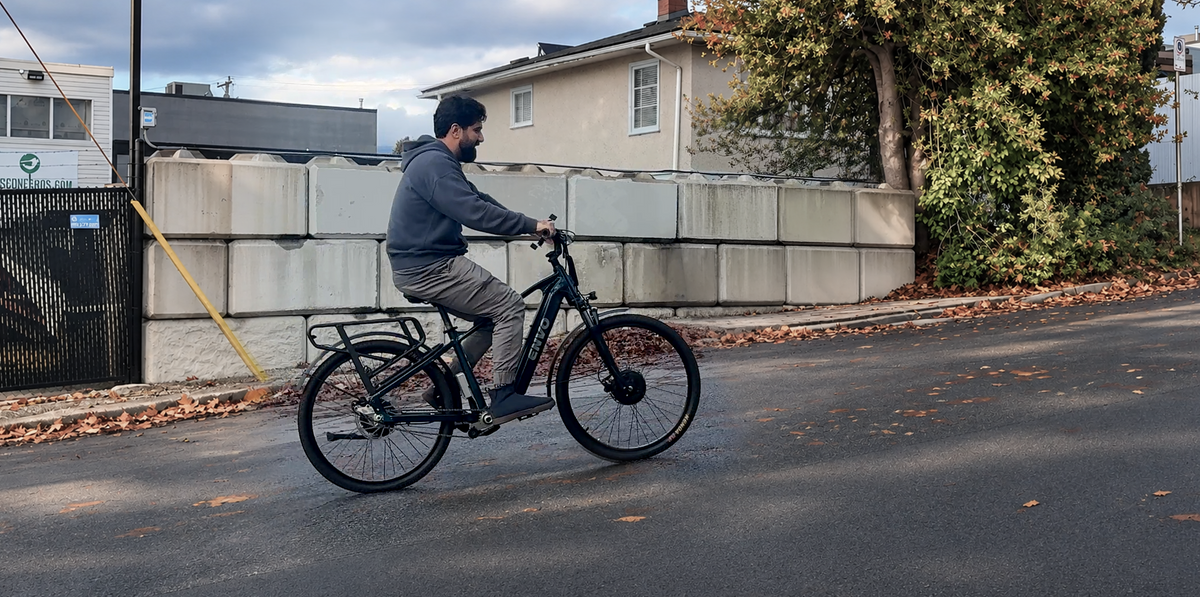
An ENVO D50 has been modified with a dual-motor drive system, electronic continuously variable transmission (eCVT), regenerative braking and anti-lock braking (ABS). The project brings together technologies from Grin Technologies on the D50 platform, combining front and rear hub motors with electronically managed power delivery and a simplified mechanical drivetrain.
The modified bike demonstrates a different approach to electric bicycle propulsion, integrating motor control, pedaling input and braking into a coordinated system.
Dual-Motor Drive System
The modified D50 uses two electric hub motors, one mounted in the front wheel and the other in the rear. Unlike the original single-motor configuration, both motors can operate simultaneously, delivering power to both wheels.
This arrangement distributes propulsion between the front and rear wheels and enables coordinated motor operation during acceleration and electric braking. It also provides a platform for evaluating power distribution, traction management and performance under different operating conditions.

Electronic Continuously Variable Transmission (eCVT)
One of the central modifications is the integration of an electronic continuously variable transmission (eCVT). Instead of relying on conventional mechanical gear shifting, the system uses electronic control to manage the relationship between pedaling input and electric propulsion.
The configuration is designed to maintain a consistent pedaling cadence while automatically adjusting motor assistance according to riding conditions. This eliminates the need for conventional manual gear changes.
The eCVT operates alongside the dual-motor configuration, allowing electronic control to manage power delivery without requiring multiple mechanical gear ratios.
Modified Chain Drive and Gear Ratio
The D50's mechanical drivetrain has also been modified. A smaller front chainring has been installed, creating a significantly lower fixed chain-drive ratio.
This reduces the mechanical gearing between the pedals and rear wheel, replacing multiple conventional gear ratios with a simplified chain-drive arrangement.
Combined with the eCVT system, the modified gearing supports a consistent pedaling cadence while reducing the complexity of the mechanical drivetrain.

Regenerative Braking and ABS
The modified D50 integrates regenerative braking and an anti-lock braking system (ABS). During regenerative braking, the electric motors operate as generators, converting part of the bicycle's kinetic energy into electrical energy.
Both front and rear motors can contribute to electric braking, while ABS provides additional control by managing wheel lockup during deceleration.
These electronically controlled braking functions operate alongside the conventional mechanical braking system, providing an additional layer of braking control and contributing to overall rider safety.
Motor Controllers and Electronic Integration
The project incorporates updated motor controllers that coordinate the operation of both hub motors and support the electronic transmission and braking functions.
By managing motor assistance, pedaling input and electric braking through a coordinated control system, the modified D50 demonstrates how these functions can operate together within a single drivetrain architecture.

Who Could Benefit from This Technology?
The modified D50's drivetrain configuration could be particularly relevant to riders and applications that require adaptable power delivery.
Daily commuters navigating urban routes with frequent stops and elevation changes, riders in hilly regions requiring additional climbing assistance, and cargo or utility e-bike users carrying heavier loads could all benefit from this type of system.
The combination of dual-motor propulsion, automatic eCVT and electronically controlled braking also presents opportunities for future specialized e-bike applications.
Exploring Advanced E-Bike Drive Systems
The modified ENVO D50 brings together dual-motor propulsion, eCVT, a low fixed chain-drive ratio, regenerative braking and ABS within an existing electric bicycle platform.
The project provides a practical example of how an existing e-bike can be adapted to evaluate alternative approaches to propulsion, transmission and braking, with potential applications in future electric mobility development.
Share:
Meet the ENVO Stax DropBar: A Sub-$3,000 Drop-Bar E-Bike Built for Canadian Riders