

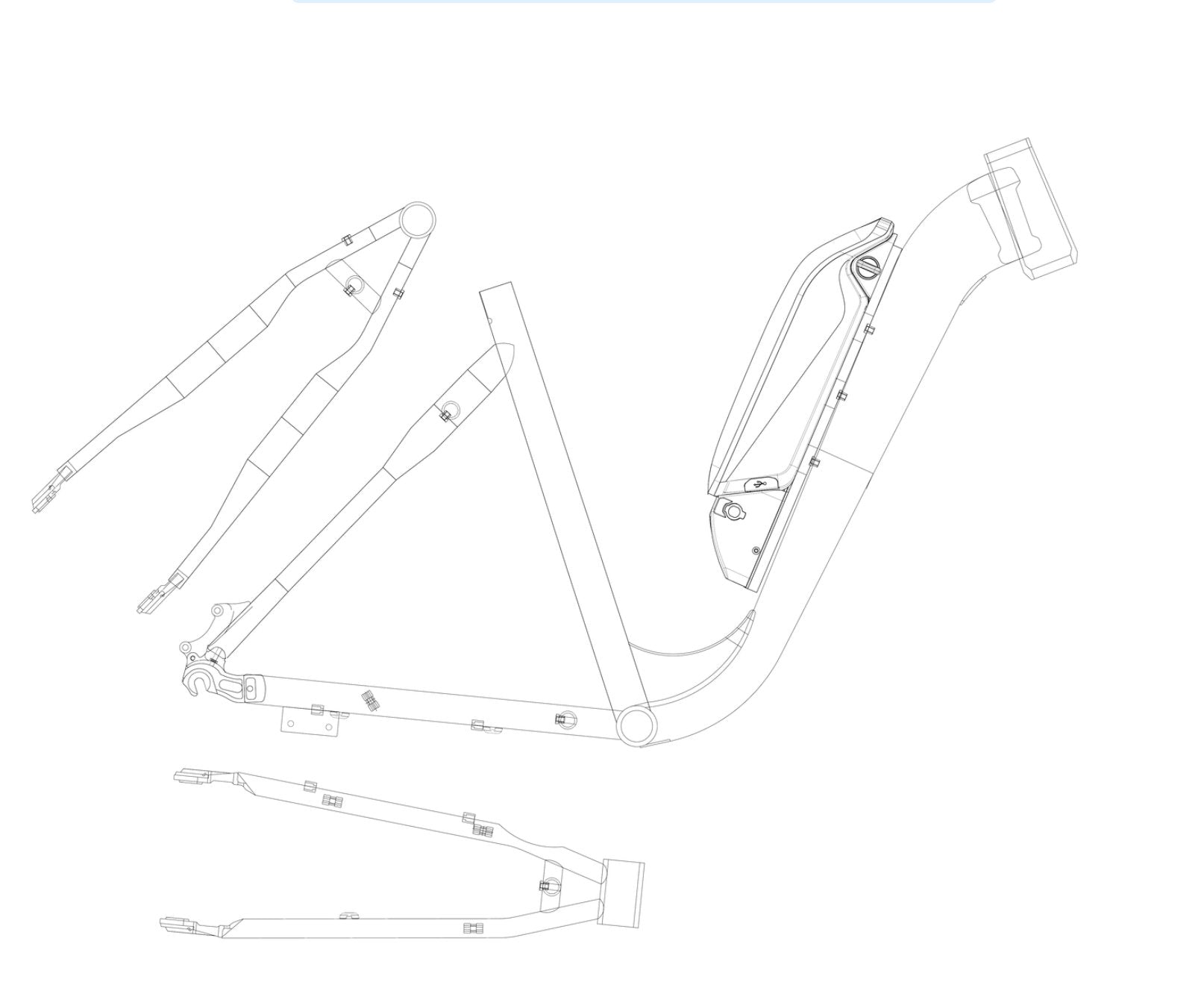
The ENVO D35 had done what a first platform is supposed to do: prove that a Canadian electric bike company could deliver reliable performance at a competitive price. Dealers were growing. Riders were returning. The feedback was largely positive.
But something was missing. Not from the product itself, but from who the product reached.
A significant share of interested riders, particularly women, seniors, and comfort-oriented commuters, found the D35 frame geometry a barrier to confident daily use. The solution was not a new platform. It was a new frame shape built on the same proven foundation.
Why ST Started
The ST project began in 2020 under the technical direction of Ali Kazemkhani. The commercial case was already clear before design work started. Dealers who had been successfully selling the D35 were asking a consistent question: when is the step-through version coming?
That question, repeated across multiple dealer conversations, was not simply a product request. It was a direct signal that ENVO's first platform had a reachable adjacent market, and that expanding into it would not require building a new powertrain, new battery system, or new service infrastructure.
The electrical system that had already proven itself in the D35 would carry forward. The challenge was entirely structural.

The Core Engineering Challenge
Removing the top tube from a bicycle frame is not a cosmetic change. It fundamentally alters how the structure behaves under load.
A conventional diamond frame distributes rider weight and road input through a closed triangle. That triangle is efficient, stiff, and well-understood. A step-through frame opens that triangle, which immediately introduces new demands in three areas: bending stiffness along the longitudinal axis, torsional rigidity when the rider applies asymmetric pedal force, and fatigue behavior at the frame junctions under repeated cycling load.
Without the top tube, the main frame section must carry longitudinal bending loads that were previously shared across a triangulated structure. Tube cross-sections and wall thicknesses had to be recalculated accordingly.
Asymmetric pedal forces generate torsional loading across the bottom bracket region and chainstay junction. The open step-through geometry required careful attention to tube geometry to control frame flex under load.
Frame welds on a step-through design carry a different stress profile than those on a diamond frame. Junction geometry and weld placement were designed to manage long-term cyclic stress accumulation.
ENVO was still an early-stage company scaling carefully. New tooling and mold investment had to remain economically realistic for lower launch volumes. Engineering decisions were made with cost targets in view throughout.
The frame also had to remain visually related to the D35. A rider seeing both bikes on a dealer floor needed to recognize them as family. That visual identity constraint added design discipline to what was already a structural problem.
The target was not simply to make mounting easier. The frame had to preserve D35 ride confidence, visual identity, urban practicality, and manufacturing affordability, all while solving structural challenges that open geometry inherently introduces.
The D Series Kit: Shared Electrical Foundation
One of the most important decisions made during the ST project was the decision not to create a new electrical system for it. The D-Series conversion kit architecture, already proven through D35 production and field use, carried directly into ST.

This meant dealers already familiar with D35 service could work on ST without additional training. Spare parts were shared. The battery system was interchangeable. Customer confidence transferred directly from one model to the other because the core electrical experience was identical.
This is a principle that became important across ENVO's product development: when a new frame variant is needed, isolate the change to the frame. Preserve the electrical platform. The result is a broader product range with lower service complexity.
First Production and Market Impact
The first ST units reached production in 2021. The market response confirmed what the dealer feedback had suggested. The bike reached riders who had previously been hesitant with conventional frame geometry, and it did so without introducing any new complexity into the dealer service model.
Technical direction established under Ali Kazemkhani. Frame engineering begins with the goal of retaining D35 electrical systems while solving the structural challenges of a step-through geometry.
Structural design work completed. Frame geometry, tube profiles, and junction design finalized to meet stiffness, durability, and manufacturing cost targets simultaneously.
ST reaches market. Immediate uptake among women, seniors, and comfort-focused commuters. Dealer response confirms that the expanded model range increased sales without adding service complexity.
As the 35-series family grew, the ST was formally identified as ST35, reflecting its position within the platform family and its relationship to future product generations.
Historical Significance
ST35 matters historically not just because it sold well, but because of what it established as a product development principle within ENVO.
The D35 had proven that ENVO could build a competitive electric bike. ST35 proved that a single electrical platform could support multiple rider identities without fragmenting the product line. That logic, one proven drivetrain supporting diverse frame variants, became a foundational principle across ENVO's subsequent development work.
ST35 also established ENVO's first strong presence in the female and senior rider segments, two demographics that represent substantial long-term market opportunity and that respond strongly to product confidence, after-sales support, and accessible frame geometry.
ST35 became the parent of the ENVO ST50, and its influence extended into broader 50-series thinking: stronger motors, larger batteries, more integrated systems, and new frame generations all emerged from lessons first worked through in the ST35 project. The step-through frame was not a derivative product. It was a platform expansion that shaped ENVO's product architecture for years forward.
Watch the ENVO ST in Action
ENVO ST: step-through design, D-Series electrical platform, built for confident everyday riding.
The ST Legacy Lives On.
Explore the current ENVO step-through lineup, built on the same platform principles established in 2020.
Explore ENVO E-Bikes
Share:
ENVO Lynx: The Compact E-Bike That Opened a New Direction
ENVO Lynx: The Compact E-Bike That Opened a New Direction