

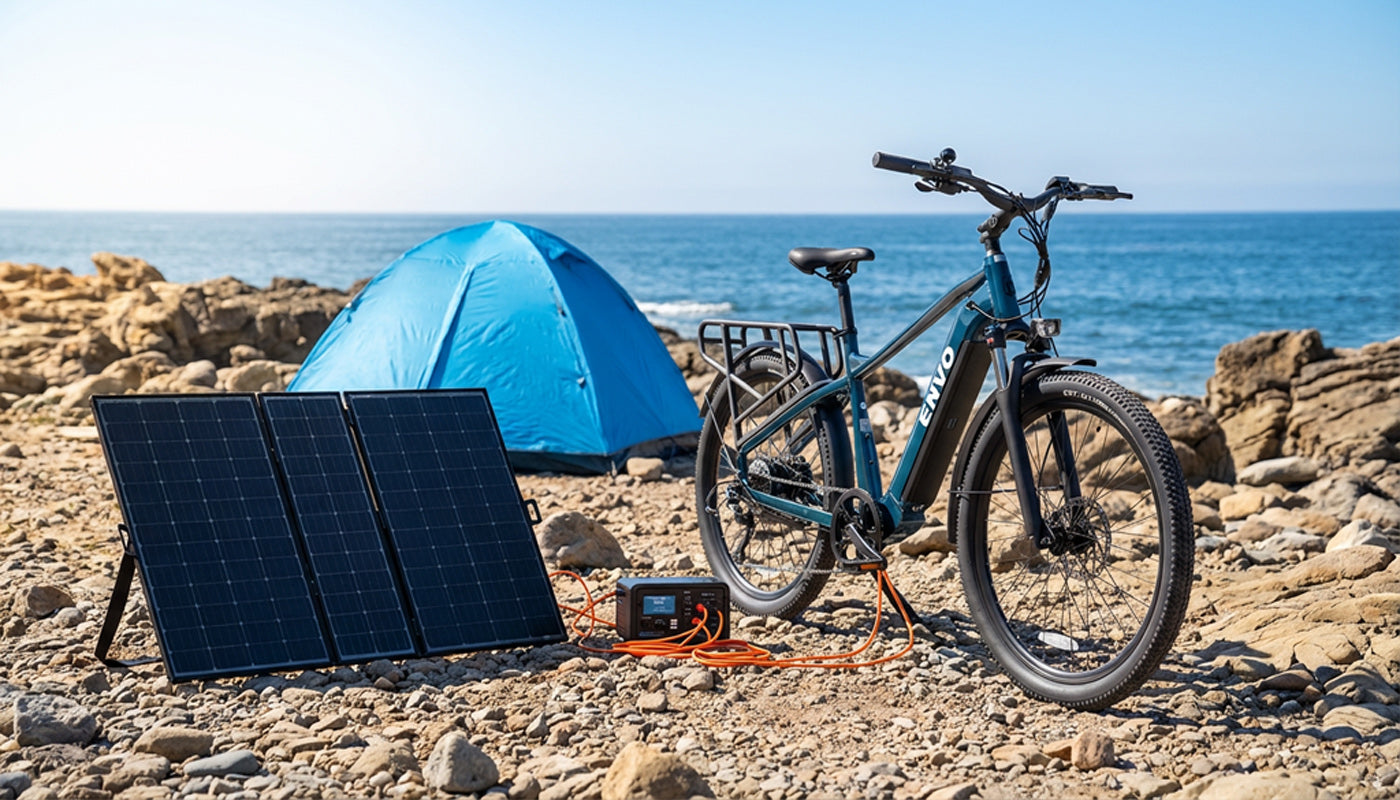
Solar charging for e-bikes sounds simple in theory: add a solar panel, plug it into a battery, and ride on sunshine.
In reality, charging an e-bike with solar power requires careful system design. Power requirements, battery chemistry, voltage compatibility and most importantly, charger–battery communication and safety protocols all matter. Without the correct setup, solar charging can be slow, inefficient, or unsafe.
This guide explains how solar charging for e-bikes actually works, what to look for before buying a solar solution, and the only safe and recommended way to charge modern lithium-ion e-bike batteries using solar power.
Can You Really Charge an E-Bike With Solar Power?
Yes, but with clear limitations.
Most e-bike batteries store between 400Wh and 750Wh of energy, while portable solar panels produce relatively modest power. In practice, solar charging works best as a supplemental or staged charging solution, not as a fast replacement for grid charging.
A properly designed solar setup can:
-
Extend riding range over multiple days
-
Partially recharge during long stops
-
Enable off-grid or remote use
-
Reduce dependence on wall charging
What solar charging typically cannot do is quickly recharge a large e-bike battery from empty in one session.
The Only Safe Way to Charge an E-Bike With Solar
🔒 Use AC Power and the Manufacturer-Approved Charger Only
This is non-negotiable.
Modern e-bike battery chargers are designed to operate from 110V or 220V AC power, exactly like a household wall outlet. As a result, the only safe and recommended way to charge an e-bike using solar power is:
Solar panel → regulated solar generator or power station (110/220 V AC output) → original e-bike charger → battery
Direct DC charging, generic DC chargers, or bypassing the original charger introduces serious safety risks and should not be used.
Why the Original E-Bike Charger Is Mandatory

Lithium-ion e-bike batteries require tightly controlled charging behavior. Manufacturer-approved chargers are matched to:
-
Exact charge voltage and cutoff limits
-
Current ramp-up and taper profile
-
Battery Management System (BMS) logic
-
Temperature, fault, and cell-balance protection
Using a third-party or generic charger, even if voltage and current appear correct, can:
-
Stress or imbalance individual cells
-
Bypass BMS safety assumptions
-
Cause overheating or internal damage
-
Increase fire risk
-
Void battery and bike warranties
If a solar setup cannot safely power the original charger, it is not compatible with the e-bike battery.
ENVO and Modern European-Standard E-Bikes: CAN-Bus Charging Architecture
Many modern e-bikes that follow current European safety and system standards, including ENVO 50 Series ebikes, use CAN-bus–based battery and charger architectures.
What This Means in Practice
ENVO chargers and batteries do not operate as simple voltage-in / current-out systems.
Instead:
-
The charger controller and battery BMS communicate continuously
-
Charging is dynamically adjusted based on:
-
Individual cell balance
-
Battery temperature
-
Pack voltage
-
Charge current
-
Fault and safety states
This communication uses proprietary protocols.
No third-party charger, DC converter, or solar controller can safely initiate or maintain charging unless it fully matches the ENVO charger protocol.
Critical Implication for Solar Charging
Unless ENVO (or a similar manufacturer) explicitly designs and releases a proprietary solar-compatible charger, there is no alternative safe method to charge these batteries via solar other than:
Solar generator with 110/220V AC output → ENVO-specific standard charger → ENVO battery
Any attempt to feed DC voltage directly into the battery, regardless of regulation, will not work safely and may damage the battery or disable the BMS.
Charger Power Requirements (What Solar Systems Must Support)
Most standard e-bike chargers operate at:
-
36 V, 48 V, or 52 V systems
-
2–4 A charge current
Typical charger power demand:
-
36 V × 4 A ≈ 145 W
-
48 V × 3 A ≈ 145 W
-
52 V × 3 A ≈ 155 W
Correct Power Supply Sizing Rule
The AC power source should be rated for no less than 125% of:
Output voltage × output current (in watts)
Example:
-
150W charger → minimum ~190W continuous AC output
This requirement limits viable solar solutions to solar generators or power stations that:
-
Provide stable 110/220V AC output
-
Can continuously supply the charger’s required power
Why This Method Is Not the Most Efficient, but Is the Only Safe One
Yes, this charging path involves multiple conversions:
-
Solar DC → AC (inverter)
-
AC → battery DC (charger)
This introduces energy losses at each stage. However:
-
It preserves the battery’s designed charge profile
-
It maintains all BMS and CAN-bus safety logic
-
It eliminates unsafe voltage or current assumptions
This is the most practical and the only safe charging method for modern lithium-ion e-bike batteries.
Efficiency losses are a reasonable trade-off for safety, longevity, and warranty protection.
Solar Panel Output: Realistic Expectations
Portable solar panels typically range from:
-
50–100 W (compact, foldable)
-
100–200 W (larger or stationary)
In good conditions, a 100W panel may produce 300–500Wh per day, enough for:
-
Partial recharging
-
Meaningful range extension over time
Solar charging rewards patience and planning, not speed.
Common Mistakes to Avoid
-
Charging e-bike batteries directly from solar panels
-
Using non-approved or DC fast chargers
-
Ignoring CAN-bus or BMS communication requirements
-
Under-sizing solar generators
-
Expecting fast full charges from small panels
Most lithium-ion battery incidents occur during improper charging, not riding.
Is Solar Charging Worth It for E-Bikes?
Solar charging makes sense if:
-
You ride long distances over multiple days
-
You spend time off-grid or outdoors
-
You want backup or emergency charging
-
You value sustainability over speed
It is less practical if:
-
You need fast daily full charges
-
You lack consistent sun exposure
-
You want a simple, lightweight solution
Final Takeaway
For ENVO and other modern CAN-bus–based e-bikes:
-
Always use the manufacturer-approved charger
-
Always supply it with regulated 110/220V AC power
-
If a solar system cannot do this safely, it should not be used
Until manufacturers release proprietary solar chargers, AC solar generators paired with the original charger remain the only safe solution.
Share:
All-Weather Cycling and Commuting: What It Really Takes to Ride Year-Round
Electric Bikes for Police: Why Law Enforcement Chooses the ENVO D50