

In December we wrote that Rad Power Bikes had run out of road: revenue cut roughly in half in a year, about $73 million of liabilities against $32 million of assets, and more than $230 million in accumulated losses. You can read that analysis here. Eleven months on, the brand is selling e-bikes again, and for the first time we can look at audited numbers from the company that now owns it.
The numbers come from a Form C-A filed with the U.S. Securities and Exchange Commission, the audited financial statements attached to it, and the company’s investor page. The new owner, Rad Life Mobility, is raising money from the public through Regulation Crowdfunding, which obliges it to disclose details most private companies never would. Here is what the filings show, what they leave out, and what it means if you ride a Rad or are thinking of buying one.
A note on perspective. ENVO competes with Rad Power Bikes. Every figure below comes from the public documents listed at the end, and where a number is our own arithmetic we say so. This is analysis of public filings, not investment advice.
A new company:Not the old one.
The first thing to understand is that Rad Life Mobility, Inc. is not Rad Power Bikes Inc. It was formed in February 2026, weeks after a bankruptcy auction on January 22 that Life Electric Vehicles Holdings (Life EV), a Florida light-electric-vehicle company, won with a bid of about $13.2 million, or $14.9 million once obligations are included, according to TechCrunch. Retrospec bid $13 million as the backup. The court approved the sale on January 30 and, per the filing, the deal closed on February 27.
What came across was the brand, the intellectual property, inventory, the website and customer database, and the retail operations. What did not come across was nearly all of the old company’s liabilities. The filing says Rad Life assumed only gift cards and certain named warranty obligations. The tariff disputes, litigation and creditors we described in December stayed behind in the bankruptcy estate. Rad Life itself has told customers it is an independent company, not affiliated with Rad Power Bikes Inc., according to Electrek. The filing does flag one caveat: it cannot rule out that a court or regulator could someday try to pursue the new company on a successor-liability theory.
That is why the two balance sheets look so different. The old company entered Chapter 11 with roughly $32 million of assets and $73 million of liabilities. Rad Life’s audited balance sheet at June 30 shows $18.6 million of assets and $7.4 million of liabilities.
$7 million in four months:What it does and does not show.
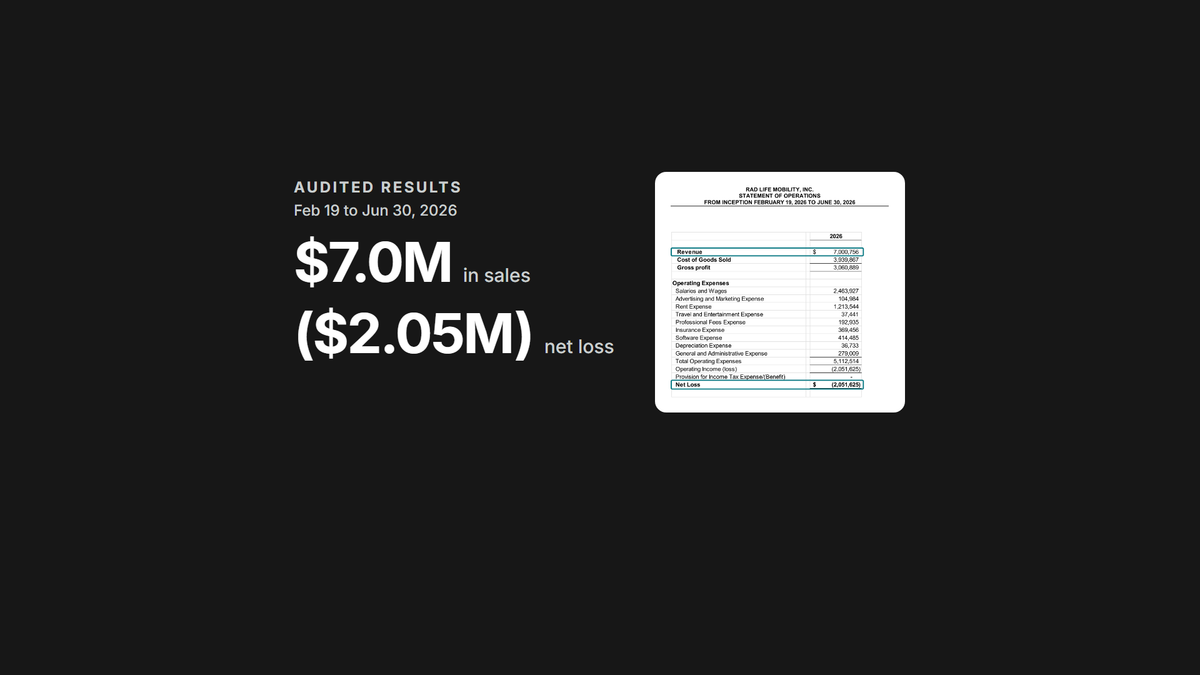
Start with the good news, because there is real good news. Booking $7.0 million of sales in the first four or so months, from a standing start, is a genuine result, and a 43.7% gross margin is healthy for a hardware business. The auditor’s report is a clean opinion, and we found no going-concern warning in it.
Now the other half. The same statements show $5.1 million of operating costs. Gross profit of $3.1 million covered only about 60% of them, leaving a net loss of $2.05 million, roughly 29 cents on every dollar of sales.

The audited Statement of Operations from Exhibit A, February 19 to June 30, 2026. Revenue and net loss are outlined.
Two things stand out. First, the cost base is mostly fixed: salaries and rent make up 72% of operating expenses, and rent alone took 17 cents of every sales dollar. Second, advertising was just $104,984, or 1.5% of revenue. That fits the company’s pitch that it sells largely to an owned list of past customers, and it also means the cost of winning brand-new buyers has not been tested yet.
For every $1.00 of sales, the company spent about $1.29. Audited figures, our arithmetic.
Break-even
At a 43.7% gross margin and the same $5.1 million of operating costs, a period like this one would need about $11.7 million of revenue to break even, roughly 67% more than the company booked.
Run rate
Spread over the roughly four months of selling the company describes, $7.0 million is about $1.56 to $1.75 million a month, or $19 to $21 million a year. That is about a third of the $63 million Rad Power Bikes reported for 2024.
Both are simple extrapolations, not forecasts.
The balance sheet:Inventory-heavy, cash-light.
Of $12.75 million in current assets at June 30, $10.97 million, or 86%, was inventory. Cash was $599,355. Against that sit $7.09 million of accounts payable and accrued liabilities, almost 12 times the cash balance.

The audited balance sheet from Exhibit A at June 30, 2026. Cash, inventory and accounts payable are outlined.
That is not unusual for a young hardware company stocking up for the season, and inventory is only an asset if it sells. In December we noted that the old Rad carried more than $14 million of stock, much of it marked as excess or obsolete. The filing does not say how much of the new company’s $11 million is stock inherited from the bankruptcy estate. That is the question we would most like answered.
Cash at June 30, 2026: $599,355. Source: Exhibit A, Statement of Cash Flows.
Put simply, the company used about $12.7 million of cash on stock, payroll, rent and the assets it bought, and covered it with $13.3 million paid in by shareholders, overwhelmingly the parent group (Life EV holds about 95.5% of the shares).
Since then the company has gone looking for more. The latest amendment, posted in early November, shows three concurrent raises: up to $5 million from the public under Regulation CF, up to $15 million from accredited investors under Regulation D, and up to $2 million of convertible notes paying 12% a year. The proceeds of the last two are earmarked for more inventory. As of that amendment, the crowdfunding portion had closed twice (September 28 and October 8) for a total of $86,466, about 1.7% of its $5 million ceiling.
None of this says the company is in trouble. Raising money to fund inventory is what growing companies do, and the auditor flagged no going-concern doubt. It does show how much the relaunch still depends on outside capital, and the filing itself warns that the company may have to turn to a related party for more.
The $205 million question
Crowdfunding investors are asked to pay $1.00 a share. With 205.5 million shares outstanding, that works out to a pre-money valuation of $205.5 million, a figure the company says management set on its own, with no independent valuation or appraisal. Here is how that price tag compares with the company’s own numbers.
Price per share. The 205.5 million shares issued so far brought in $13.3 million in total. Our arithmetic.
- The valuation is 29 times the revenue reported to date, or about 10 times on an annualized basis.
- It is 14 times the $14.9 million paid for the Rad assets.
- It is about 12% of Rad’s own 2021 valuation of roughly $1.65 billion.
- Management, directors and advisors hold 19.5 million options at $0.10 a share, granted in March.

The cover of the latest Form C-A. The price, the December 31 deadline and the two closings to date are outlined.
Early investors have been offered sweeteners: 20% bonus shares for investments through November 30, up to 50% for existing Rad owners and Life EV shareholders, and gift cards worth up to $3,000 for every $25,000 invested. The two closings to date issued 128,950 shares for $86,466.
The structure matters too. Shares in the offering carry an irrevocable voting proxy in favour of the Executive Chairman, Life EV holds about 95.5% of the stock, and as with any crowdfunded security there is no public market. The filing also discloses a Florida court case in which a noteholder claims about 4% of the company. The company says the correct figure is 0.4%.
For a rider, the valuation is not the point. The point is whether the company can fund parts, batteries and warranty service for the e-bikes already on the road.
What it means:If you ride a Rad.
To its credit, the company is candid about the rough patches. In its investor disclosures it says that since the acquisition some customers have experienced limited availability of parts and batteries and longer fulfilment times, and that it is working to improve them. It also acknowledges lingering reputation risk from the pre-acquisition CPSC safety warning on certain older battery packs, and in May it announced a program offering eligible owners up to 50% off replacement Safe Shield batteries, according to Electrek.
Check your warranty
Rad Life assumed only the warranty obligations named in the sale documents. The June 30 balance sheet carries a warranty liability of about $330,000. If you bought before December 2025, ask the company to confirm in writing what applies to your serial number.
Where it is built
Manufacturing and assembly currently run through LEV Manufacturing, an affiliate in which Life EV holds about 40%. A 9,300 square metre (100,000 square foot) Tennessee assembly centre is being built out, with Foreign-Trade Zone status planned. Per the filing, that status is not yet active, so the hoped-for duty savings have not arrived.
A checklist:For any brand after a restructuring.
What happened to Rad is a useful stress test for any e-bike purchase. Whoever you buy from, ask four questions.
Who stands behind the warranty?
Get the coverage in writing, with the legal entity named, and confirm it applies to your serial number.
Can you see the parts?
A public parts catalogue with prices is a better sign than a promise. Check that the battery, charger, controller and display for your exact model are listed.
Is the battery documented?
Ask which safety standard the battery and charger are certified to, by whom, and whether any recall or safety notice covers your unit.
Who will service it?
Count the shops near you that will actually work on the e-bike, not the number on the website.
For what it is worth, ENVO lists its spare parts catalogue with prices on envodrive.com, and a dealer finder shows who sells ENVO e-bikes near you. We are a competitor, so judge us by the same four questions.
What we are watching next
- The next financials. The audited numbers stop at June 30. The next set will show whether losses narrowed as sales continued.
- The raise. Whether the crowdfunding round gains traction before its December 31 deadline, and how the Regulation D and note raises fare.
- Parts and batteries. Whether availability improves, and whether the Tennessee Foreign-Trade Zone activates on schedule.
- The inventory. How much is legacy stock, and whether it clears without heavy discounting.
Frequently asked questions
Is Rad Power Bikes still in business?
Yes, as a brand. Rad Life Mobility, Inc. bought the core assets of Rad Power Bikes out of bankruptcy in February 2026 and now sells Rad, QuietKat and, as exclusive reseller, Serial 1 e-bikes. By its own description it is not a continuation of the old company.
Who owns Rad Power Bikes now?
Rad Life Mobility, Inc., a Nevada corporation. Life Electric Vehicles Holdings (LFEV) owns about 95.5% of its shares.
Is Rad Life Mobility profitable?
Not yet, on the only audited numbers filed so far. For February 19 to June 30, 2026 it reported $7,000,756 of revenue and a net loss of $2,051,625. No later audited period has been published.
Were Rad Power Bikes warranties honoured after the bankruptcy?
The filing says Rad Life assumed only gift cards and certain warranty obligations named in the sale documents, not the old company’s general liabilities. If you bought your e-bike before December 2025, ask the company to confirm in writing what coverage applies to your serial number.
What was the Rad Power Bikes battery warning?
In late 2025 the U.S. Consumer Product Safety Commission warned owners about certain older Rad battery packs after reports of overheating and fire risk. In May 2026 Rad Life announced a program offering eligible owners up to 50% off replacement Safe Shield batteries, according to Electrek, which noted that the eligible models were not specified.
Sources and further reading
- SEC EDGAR: Rad Life Mobility, Inc., Form C-A (latest amendment, posted early November 2026)
- SEC EDGAR: Rad Life Mobility, Inc., Form C-A (September 2026 version)
- SEC EDGAR: Exhibit A, audited financial statements, period ended June 30, 2026
- Highlander: Rad Life Mobility investor page, including company disclosures
- TechCrunch: Rad Power Bikes reaches deal to sell itself for $13.2M (January 26, 2026)
- Electrek: Rad Power Bikes to offer safer replacement e-bike batteries at steep discount (May 26, 2026)
- Bicycle Retailer: Rad Life Mobility begins regulation crowdfunding campaign (August 27, 2026)
- ENVO: Rad Power Bikes is Bankrupt, what happened (December 17, 2025)
Figures are as stated in the documents above as of November 12, 2026. The crowdfunding offering and its terms have been amended several times and may change again.
Questions about your e-bike?
Whatever you ride, ENVO’s team is happy to talk parts, batteries and what to ask before you buy.
Explore ENVO e-bikes
Share:
ENVO D50 Modified with Dual Motors, eCVT and Advanced Braking Technology