

The e-bike industry has a habit of treating mid-drive motors as the premium technology, the thing serious riders should want and hub motors as the budget option you settle for. ENVO does not share that view.
Based on our engineering and product-development experience, and years of testing electric mobility systems across e-bikes, trikes, and other light electric vehicles, we believe a properly designed geared hub motor is the smarter powertrain for almost every e-bike application outside serious all-mountain riding. That is not a cost-cutting position. It is an engineering one.
Mid-drive is marketed as inherently superior because it uses the bicycle's gearing and sits low and central on the frame. Marketing preference is not the same as engineering advantage, and for most riding, it does not hold up.
Why Hub Motors Win for Almost Everything
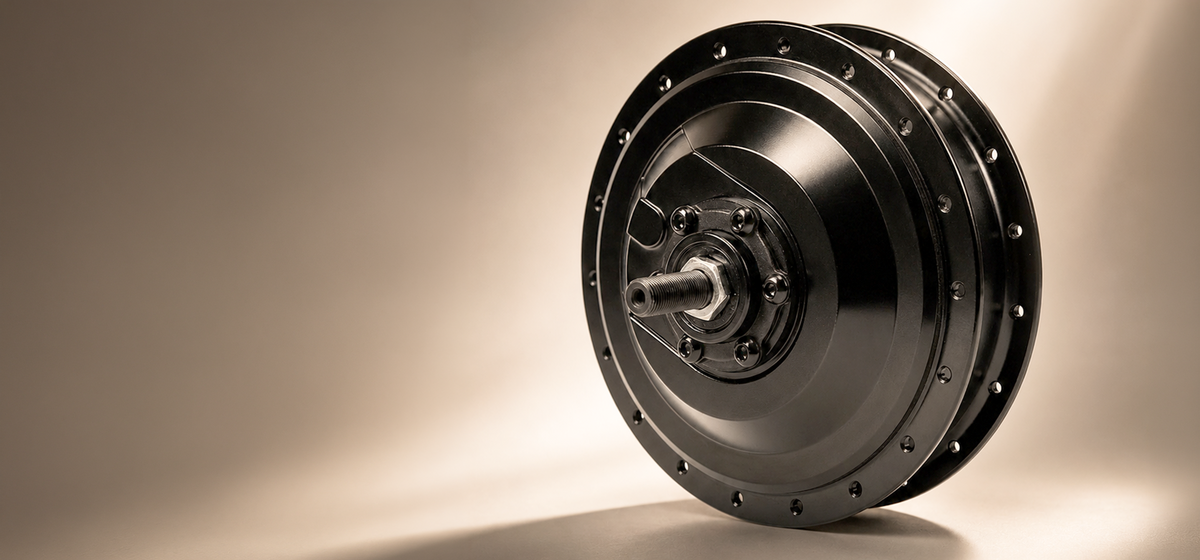
The geared hub motors ENVO uses on its 50 Series are compact, lightweight, powerful, and mechanically simple. At a 1:1 wheel-to-motor comparison, ENVO's hub system can produce maximum wheel torque comparable to leading Shimano and Bosch mid-drive systems, and already beyond what urban, trekking, cargo, and recreational riding actually require.
Torque is only part of the story. For comparable motor weight, ENVO's hub architecture delivers higher maximum power, higher power density, and instant motor response, while running quieter and putting less stress on the rest of the bike.
Fewer moving parts and a simpler mechanical path mean fewer failure points over the life of the bike.
A hub motor is easier to diagnose and service than a motor and gearbox packaged into the bottom bracket.
Power goes straight to the wheel, not through the chain, cassette, and derailleur, so those parts last longer.
A simpler system means fewer parts that wear out, fewer things that can go wrong, and a lower cost to keep it running.
A hub motor also benefits from a physically larger rotor and stator, and more external surface area for heat dissipation. A mid-drive has to package its motor, reduction gearbox, and transmission geometry into a very confined space around the bottom bracket, which forces a smaller rotor and stator paired with a more complex high-speed reduction system.
The hub motor has one more fundamental advantage: it replaces the conventional bicycle hub instead of adding to the bike. A mid-drive motor, gearbox, and associated structure are extra components bolted onto the bicycle. The hub motor integrates propulsion into a component the bike already needs.
Why Add a Transmission You Don't Need?
Electric motors do not inherently need the multi-speed mechanical transmission architecture that was developed for internal-combustion engines. A hub motor transfers power directly at the wheel without routing it through the bicycle's chain, cassette, and derailleur. The result is a simpler drivetrain with fewer stressed components between the motor and the road.
This philosophy extends well beyond ENVO's bicycles. Our engineering work on VEEMO, UPT, MoonBike, SnowKart, and other light electric vehicles keeps demonstrating the same thing: eliminating unnecessary mechanical transmission and bringing electric propulsion as close as practical to the driven wheel improves the vehicle. For the applications ENVO engineers, our hub-motor technology has shown superior performance in the areas that matter most: power, efficiency, simplicity, reliability, durability, responsiveness, serviceability, and cost.

Where Does Mid-Drive Win?
There is one application where ENVO deliberately chooses mid-drive: full-suspension, all-mountain e-bikes.
Technical mountain riding involves jumping, aggressive suspension movement, and difficult terrain, where minimizing unsprung wheel mass becomes genuinely important. A mid-drive's ability to use the bike's mechanical gearing also helps during extreme low-speed technical climbing. That is why the ENVO M50 uses a high-end, lightweight mid-drive system.
It is not because ENVO considers mid-drive inherently superior. It is because the M50's specific all-mountain application justifies it. For our other e-bikes, we have the engineering capability to use Bosch, Shimano, or other mid-drive systems if we choose. We simply do not believe that would produce a better bicycle.
Engineering Before Industry Trends
ENVO's decisions are not dictated by what the largest component manufacturers want to sell to bicycle factories. They come from our own engineering. With roughly 26 years of product-development experience behind our engineering leadership, and more than a decade of ENVO electric-mobility development, our approach has always been to examine the complete vehicle rather than follow an industry trend.
For the vast majority of the e-bikes we build, that engineering process points to the same conclusion: a modern geared hub motor is the smarter electric powertrain. Mid-drive has its place, and for ENVO, that place is serious all-mountain riding. Everywhere else, we will keep advancing hub-motor technology and building products around the simplicity, performance, and reliability of direct-to-wheel electric propulsion.
Trust the Application. Trust the Engineering.
See the geared hub motor platform behind the 50 Series, and the mid-drive system built specifically for the M50's all-mountain application.
Explore ENVO E-Bikes
Share:
One Core System. Every 50 Series eBike
How to Convert a Class 2 E-Bike to Class 1 for Parks and Trails